Saturday, April 12, 2025

"When Jesus Left His Father's Throne" and savoring the Liturgy of the Palms


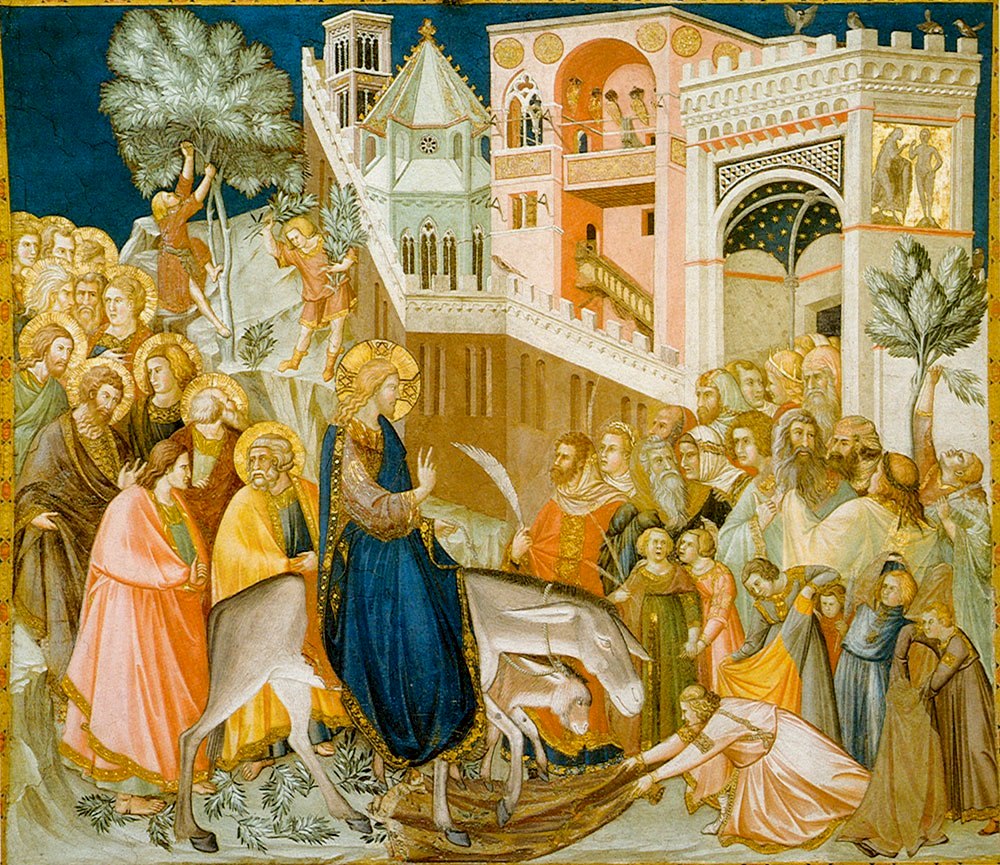
In the Palm/Passion Sunday liturgy, it seems the theologians who crafted it wanted to get the joyous and triumphant entry of Jesus into Jerusalem out of the way quickly and move right into the Passion. But I think that we in the pews want to savor it, especially the children, who eagerly wave the fronds. And hymnodists throughout Christian history have celebrated the event. “All Glory, Laud and Honour” is John Mason Neale’s translation of a Latin hymn written by Theodulf of Orléans in 820. A thousand years later, in 1820, Henry Hart Milman penned “Ride On, Ride On in Majesty.” Even Andrew Lloyd Webber and Tim Rice made a hit out of “Hosanna” in “Jesus Christ Superstar” (1970). 

One beloved Palm Sunday hymn, “When Jesus Left His Father’s Throne” (Hymnal #480), doesn’t even mention Jesus’ entry until the third and final stanza, but it does so through a child’s eyes. Ralph (say “Rafe”) Vaughan Williams (1872-1858), who was co-editor of the 1906 English Hymnal, heard the haunting folk song, “Dives and Lazarus,” in the Sussex village of Kingsfold, and he adapted it as a hymn tune bearing the town’s name. (Vaughan Willaims also used the song in his 1939 orchestral composition, “Five Variants of Dives and Lazarus.”) The tune surely has Celtic roots, because the Irish folk song, “The Star of the County Down” has virtually the same melody. 

Scottish-born poet and editor James Montgomery (1771-1854) wrote the lyrics for the Hallam Sunday School, near Sheffield, England, which is why it takes a child’s point of view. The first stanza is about Jesus’ birth, and the second, his blessing of the children. In the third stanza, Montgomery celebrates Palm Sunday through children’s eyes: 

When Jesus into Zion rode,

the children sang around;

for joy they plucked the palms and strowed

their garments on the ground.

Hosanna our glad voices raise,

hosanna to our King!

Should we forget our Savior’s praise,

the stones themselves would sing.


And it brings us back to that moment when there was the hope, fleeting though it was, that Jesus could bring about the Kingdom of God without the Cross. No wonder we want to savor it.


Image: Entry of Jesus Christ into Jerusalem (1320) by Pietro Lorenzetti (Wikimedia Commons)

Note This was first published in The Tower, a monthly newsletter of the Church of St. John the Evangelist, Elkhart, Indiana


Thursday, April 10, 2025

Flooding the zone and my choice to focus on passenger rail


“The real opposition is the media. And the way to deal with them is to flood the zone with shit.”

-Steve Bannon to Michael Lewis, January 30, 2018

Thanks to the Trump administration’s “Flood the Zone” tactics, it’s easy for ordinary Americans to feel powerless. That’s something Mr. Trump and his enabler, billionaire Elon Musk, are counting on. I got some wise advice from someone—either Mary Doria Russell or Heather Cox Richardson—to focus on something you know and care about. For me, that’s easy: intercity passenger train service. 

I’ve been a supporter of passenger rail for most of my life, including 32 years as an Amtrak employee. Outside of North America, rail is an integral part of the transportation system. In Europe, Japan, China, and other developed countries, passengers can travel rapidly and cheaply on well-maintained rail systems. 

But Trump and Musk don’t want Americans to have that option. Musk wants Amtrak, the quasi-public system of intercity passenger rail, to be privatized, after comparing it unfavorably to the Chinese rail system. Yet the Chinese State Railway Group is government-owned, and China has spent over $500 billion in the past five years in new tracks, trains, and stations. If Amtrak had that kind of support, it truly would be a world-class system. 

The reason Amtrak came into being was that the private railroads were unable to make money on passenger trains after the U.S. Post Office shifted first class mail off the trains and onto trucks and planes in the late 1960s. Fred Frailey, in Twilight of the Great Trains (1998) writes that most railroads kept two sets of books: one using the “fully allocated” formula demanded by the Interstate Commerce Commission, which included costs that the railroad would incur whether or not the passenger train ran; a second, based on solely related costs, showed the true expense of running a train. “In 1960,” Frailey writes, “In 1960, when the fully allocated loss on U.S. passenger trains was $485 million, the loss based on solely related expenses was a mere $10 million and would turn into a $17 million profit in 1961.” 

That all changed, beginning in 1967, when the Postmaster General, Larry O’Brien, began eliminating the Railway Post Offices—cars where first-class mail was sorted enroute. Most of the first-class mail went to trucks and planes. While some trains still carried bulk mail, the drastic cut in revenue made virtually every passenger train a money-loser, even using solely related costs. Railroad companies, which had opposed federal subsidies for passenger trains, suddenly changed their tune, and Congress, after massive discontinuance proposals, especially by the Pann Central Transportation company, passed the National Railroad Passenger Service Act of 1970, creating the National Railroad Passenger Corporation. 

When the Nixon Administration signed off on the NRPC, later called Amtrak, it added a “poison pill,” making the corporation “for profit.” While Congress changed the wording to “operated and managed as a for profit corporation” in 1978, some Amtrak opponents believe the profitability is the only way to measure Amtrak, despite the intercity passenger train’s fuel-efficiency and low carbon footprint. And, of course, they ignore massive government subsidies of other transportation modes. 

Privatization, without major spending on infrastructure and the return of mail and express to the trains, would mean a shutdown. Last year, Amtrak advocates were talking about an expansion of both short- and long-distance Amtrak service. That won’t happen if Trump and Musk get their way—the entire Amtrak system would go down. 

Former Secretary of Transportation Ray LaHood wrote in 2023, “In recent decades, America invested trillions to maintain and expand highways and air travel, while European and Asian nations invested heavily in high-speed trains. Between 1949 and 2017, the federal government invested only $10 billion in high-speed rail with $4 billion of that dedicated to the California project, compared to investments of $777 billion in aviation and over $2 trillion in highways. 

“Meanwhile, since 2004, China has invested over $1.4 trillion to build a 25,000-mile high-speed rail network and is pouring billions more into high-speed rail projects worldwide.” 

The message needs to get out. Trump and Musk can’t be allowed to destroy passenger rail.


Note: I recently sent an abridged version of this letter to Indiana Senator Todd Young, a moderate Republican who has the potential of challenging the Trump Administration. I’ve also published shorter versions in the Elkhart Truth and South Bend Tribune.


Monday, August 05, 2024

It’s like, weird, man. Like, really weird!


Former president and Republican presidential nominee and his running mate, Ohio Senator J.D. Vance have been called worse: Fascists, Nazis, Misogynists, racists, to name a few. Trump has regularly been labeled a narcissist, a megalomaniac, a rapist, and many expletives. Yet both candidates, along with much of the MAGA crowd, just shrugged them off. But when Minnesota governor Tim Walz said, “These are weird people on the other side,” on MSNBC last month, Republicans took umbrage. 

 “Weird” began as a noun, not an adjective, and meant fate. It’s a direct descendant of the Old English weorðan and a cognate of the German “werden,” both meaning "to become." 

The Online Etymology Dictionary traces the word’s change in meaning, from a noun to an adjective, and from the eerie world of the fates to the strange and curious:

“The sense of ‘uncanny, supernatural’ developed from Middle English use of weird sisters for the three Fates or Norns (in Germanic mythology), the goddesses who controlled human destiny. They were portrayed as odd or frightening in appearance, as in "Macbeth" (and especially in 18th and 19th century productions of it), which led to the adjectival meaning "odd-looking, uncanny" (1815); ‘odd, strange, disturbingly different’ (1820)” 

Since the 19th century and especially since the 1960s, “weird” has become an even milder adjective, usually meaning odd or eccentric. In 1960s counterculture, a weird experience was usually a good one. Heck, Al Yankovic made it his trademark. 

Then what is it about being called “weird” that so upsets the MAGA folks? All I can surmise is that they see themselves as the American norm, and to be labeled as deviating from that norm is a shock. 

I’ve never been offended at being called weird. But then, I’ve never been offended at being called a liberal.


Image: The norns Urðr, Verðandi, and Skuld beneath the world tree Yggdrasil (1882) by Ludwig Burger.

Monday, June 10, 2024

Left-wing Idealists and the Triumph of the Right, Part 1: How Idealists Helped Nixon


After social media interactions with idealistic young people who disparage President Biden and who appear to be planning to sit out the 2024 election rather than vote for the man they consider, at best, the lesser of two evils, I’m going back to blogging to look at some recent elections where idealists, sometimes with the best of intentions, have allowed evil to prevail. In the nearly sixty years since Lyndon Johnson defeated Barry Goldwater and “movement conservatism” in a landslide, the extreme right has made not just a comeback, but in some years a near-takeover, and this year it aims to make that takeover complete. But it can’t do so without the help of the idealists. 

In too many of the elections since 1964, we’ve seen the triumph of money and the Republican Right. Richard Nixon, Ronald Reagan, George W. Bush, and worst of all, Donald Trump have prevailed in part because idealistic people refused to vote for candidates they considered the lesser of two evils. Yes, all these Republican winners cheated to win: Nixon, by sending Anna Chennault to sabotage the Paris peace talks; Reagan, whose campaign persuaded the Iranian authorities not to release the hostages before the election; Bush, whose “Brooks Brothers Riot” shut down the recount in Miami; and Trump, who may not have “colluded” with the Russians, but publicly invited them to interfere with the campaign, which, of course, they did. 

And the Democratic losers made their share of mistakes: Hubert Humphrey waited too long to break with Lyndon Johnson on the Vietnam War; Jimmy Carter cut off grain exports to the Soviet Union, throwing the Midwest into a recession; Al Gore put a historic first—naming a Jew, Joe Liebermann, as his running mate—ahead of campaign strategy, along with refusing Bill Clinton’s help; and Hillary Clinton slighted Wisconsin, Michigan, and Pennsylvania in her campaign, along with making that “basket of deplorables” remark. 

But even with the Republican cheating and Democratic bungling, all the presidents who did so much to turn the U.S. government over to the moneyed elites and the multinational corporations would have lost without help from the idealists. 

Let’s start with 1968. Lyndon Johnson, who after becoming president after John F. Kennedy’s assassination, achieved things that had seemed impossible, beginning with the Civil Rights Act of 1964, followed by Voting Rights Act, Medicare, and Medicaid, all signed in 1965. But just a month after Johnson signed the Civil Rights Act,

the first presidential election I got seriously involved with. I turned 16 the day Minnesota Senator Eugene McCarthy announced his candidacy. I was two years away from having to register for the draft, and there seemed no end to the Vietnam War. Lawrence O’Donnell, in Playing With Fire: The 1968 Election and the Transformation of American Politics, puts it succinctly: ‘[T]he 1968 presidential election would be about nothing less than life and death. In the nuclear age, all presidential elections were, by implication at least, about life and death because the commander in chief had the power to start World War III in minutes by launching nuclear missiles. But the 1968 election was going to be about the life and death of people we knew.” O’Donnell continues: 

I was in high school in 1968, and I never heard my brothers and their college-age friends talk about career planning. They only talked about how to deal with the draft and Vietnam. There was no long-term planning, no career hopes and dreams. Life was a short-term game for many young men in 1968. It was as if they were prisoners who would only begin to think about life on the outside when they got outside. Their prison was in their pocket, the draft registration card that controlled their lives and blocked their hopes and dreams. 

(O'Donnell, Lawrence. Playing with Fire: The 1968 Election and the Transformation of American Politics (pp. 10-11). Penguin Publishing Group. Kindle Edition.) 

While I didn’t have that card in my pocket, it was just a matter of time. I was an enthusiastic McCarthy backer—I sold “McCarthy’s Million” buttons to my Cedar Falls (Iowa) high school classmates. But after Robert F. Kennedy’s assassination and the disastrous 1968 Democratic Convention, I knew that the choice was between Hubert Humphrey and Richard Nixon, and that Humphrey was a lot more likely to get us out of Vietnam. 

A lot of idealistic McCarthy supporters sat this one out or voted third-party. While South Dakota Senator George McGovern, who, after Robert Kennedy’s assassination, became a stand-in for him at the convention, endorsed Humphrey, McCarthy sat on his hands, even after September 30, when Humphrey broke with Johnson on the war. McCarthy finally issued a tepid endorsement of Humphrey on October 29. Nixon won the election by about one percent of the popular vote, though he did much better in the Electoral College. 

Julian E. Zelizer, a political historian at Princeton University, wrote in Politico on April 21, 2016: 

Crucial to Nixon’s victory was that he won states like California, Ohio, Illinois, Wisconsin, and New Jersey—all states where McCarthy had a strong following—by just a few points. Though counterfactuals are impossible to prove, it is clear that McCarthy’s active support might have created a different outcome. Humphrey believed it. “A united party working in my behalf,” he noted in his memoirs, “might have changed the electoral outcome. Those states could have been won. … Particularly in California, had McCarthy campaigned early and hard for me and the Democratic Party, he might have turned it.” McCarthy adamantly denied the charge, joking that if Humphrey had been victorious “they probably would have said it was really clever of McCarthy to hold me off.” 

While Zelizer admits that he can’t prove McCarthy’s aloofness elected Nixon, he writes that ‘…’certainly McCarthy’s refusal to help give credibility to the Humphrey campaign within the New Left did not help Humphrey’s candidacy. And the feud also had long-term effects: The Republican Party was able to use the divisions within the Democratic Party to build a powerful and lasting conservative coalition.” 

But we can’t just blame it on McCarthy, whose erratic behavior during the summer and early fall of 1968 should have been a sign that he wasn’t the leader we expected him to be back on March 12, when he had nearly beaten Lyndon Johnson in the popular vote and trounced him in the delegate count. (The upset, plus Robert Kennedy’s entry into the race, persuaded Johnson to bow out of the presidential race on March 31.) Virtually everyone who had finished high school had taken civics class and should have understood that it was either Humphrey or Nixon. And with the racist George Wallace’s third party run depriving Nixon of electoral votes in the Deep South, Humphrey had a far better chance than he might have. But, of course, he didn’t win. Nixon did, with the help of thousands of idealists. 

And with Nixon, we had four more years of war in Southeast Asia, 20,000 more American dead, and surely hundred of thousands more Asians killed.

Wednesday, November 01, 2023

"Let Us Now Praise Famous Men"


“Or wait—try All Saints. That’s what they call places when they can’t decide on a single saint.”

-Garmus, Bonnie. “Lessons in Chemistry: A Novel” 

Chemist and television cooking show host Elizabeth Zott, the main character in “Lessons in Chemistry,” is an avowed atheist, but has a soft spot for a Presbyterian minister named Wakely, who isn’t given a first name. Wakely, who gives the eulogy for Elizabeth Zott’s partner, Calvin Evans, later befriends Elizabeth’s young daughter Mad (sometimes called Madeline, but legally “Mad”), who is trying to find information about her late father. She knows he lived in a Catholic orphanage in Iowa, and while Mad can’t find its name in the Sioux City phone book (this is 1962) under “Saint,” Wakely makes the quip about “All Saints.” 

Which is a roundabout way of introducing the Feast of All Saints, celebrated in many Christian churches on November 1. It may be one of the purest Christian holidays because it’s been eclipsed by the pagan holiday it was meant to supplant. If Wikipedia and Merriam-Webster are correct, the celebration of All Saints on the first day of November began in the eighth century in the British Isles, to provide a Christian alternative to the Celtic festival of Samhain (pronounced SAH-win in Irish). 

Outside the British Isles, the feast had been celebrated in the spring, but by the ninth century the November 1 date spread across the English Channel to the Frankish Empire. By the twelfth century, November 1 had become All Saints’ Day in Western Christendom. 

Back in Britain, it wasn’t called All Saints’ Day, but All Hallows, or Hallowmas, from the Old English “hālig,” meaning “holy.” Merriam-Webster notes: 

“All Hallows' used to be a bigger deal—one 17th-century source notes that ‘the three grand days are All-hallown, Candlemass, and Ascension day’—and since important feast days usually started the night before with a vigil, the evening before All Hallows' gained its own notoriety as All Hallows' Even or All Hallows' Eve. All Hallows' Even was shortened to Hallow-e'en by the 16th century. The word Hallowe'en began to lose its apostrophe in the 18th century, though we still have some evidence for the apostrophized version.” (“The Origin of 'Halloween.' Or 'Hallowe'en'?”) 

In Celtic tradition, Samhain was a time when the line between the living and the dead became blurred, and the souls of the dead could visit the living. Some of the traditions of Samhain, such as wearing masks, carving vegetables (often turnips) into lanterns, and telling ghost stories, began to be celebrated on Hallowe’en. The Christian celebration added souling, where people went through the town asking for cakes, “soulcakes” in exchange for prayers for deceased relatives, which became the ancestor of trick-or-treating. 

Today, Halloween, without the apostrophe, is virtually divorced from All Saints’ Day. We usually celebrate All Saints’ Day on the Sunday following November 1. And of course, it isn’t just for people who “can’t decide on a single saint,” but for all the saints, known and unknown. In the traditional Episcopal lectionary for All Saints’, the first reading makes it clear:


Ecclesiasticus 44:1-10,13-14

(a commemoration of patriarchs, prophets, and other heroes of ancient Israel.)


Let us now praise famous men,

and our fathers in their generations.

The LORD apportioned to them great glory,

his majesty from the beginning.

There were those who ruled in their kingdoms,

and were men renowned for their power,

giving counsel by their understanding,

and proclaiming prophecies;

leaders of the people in their deliberations

and in understanding of learning for the people,

wise in their words of instruction;

those who composed musical tunes,

and set forth verses in writing;

rich men furnished with resources,

living peaceably in their habitations --

all these were honored in their generations,

and were the glory of their times. 

There are some of them who have left a name,

so that men declare their praise.

And there are some who have no memorial,

who have perished as though they had not lived;

they have become as though they had not been born,

and so have their children after them. 

But these were men of mercy,

whose righteous deeds have not been forgotten.

Their posterity will continue for ever,

and their glory will not be blotted out.

Their bodies were buried in peace,

and their name lives to all generations.


Image: Fra Angelico (c.1395-1455), The Forerunners of Christ with Saints and Martyrs


Thursday, April 13, 2023

Frank Tracy Griswold, R.I.P.


Frank Tracy Griswold III, tenth Bishop of Chicago and 25th Presiding Bishop of the Episcopal Church, died March 5 at age 85. A scion of a prominent Philadelphia family and a descendant of two American bishops, he was instrumental in guiding the church into an era of inclusion, including the ordination of women and members of the LGBT community. Although very much an Anglo-Catholic, he helped negotiate the church’s full communion relationship with the Evangelical Lutheran Church. And even before he was bishop, he participated in the revision of the Book of Common Prayer.

I like to think I participated in his elevation to the episcopate. In 1984 I was a member of St. Martin’s Episcopal Church, a struggling parish on the West Side of Chicago, when Bishop James Montgomery announced his impending retirement and called for a bishop coadjutor—one who would become diocesan bishop on his retirement. Bishop Montgomery had been socially liberal—he had worked with civil rights leaders, including Martin Luther King, Jr.—but he was theologically conservative. He opposed the ordination of women, though he did permit other bishops to ordain women in the diocese.

After Bishop Montgomery made his announcement, all the parishes in the diocese were given a chance to weigh in on the candidates for bishop coadjutor. And for me and the other St. Martin’s vestry members, one Frank T. Griswold stood out among the rest. We learned that he had been a member of the group that wrote the 1979 Book of Common Prayer and had been a major contributor to Eucharistic Prayer B. While I wasn’t a member of the diocesan convention that elected Frank Griswold, St. Martin’s delegates supported him.

On November 16, 1986, my wife Kathleen, a Roman Catholic, and I participated in a joint Episcopal-Catholic service. It began at St. James Episcopal Cathedral, where Episcopal Church bishops Montgomery and Griswold, and Roman Catholic Cardinal Joseph Bernardin signed a 12-point covenant between the two churches. We then processed to the Catholic Holy Name Cathedral for the joint service. Bishop Griswold later wrote of the service: “The Episcopal diocese of Chicago entered into a covenant with the Roman Catholic archdiocese in 1985, shortly after I was ordained bishop. In the covenant we agreed to share resources and to collaborate wherever possible in areas of ministry, evangelization and service to the poor and needy.” 

As Bishop of Chicago, Griswold welcomed women into the clergy. His Anglo-Catholic credentials helped ease that transition—by 1997, when he left the Chicago to become Presiding Bishop, 41 of the diocese’s 146 priests were women. In 1994 he was one of 80 bishops to sign a statement declaring sexual orientation to be “morally neutral” and that “faithful, monogamous, committed” gay relationships were worthy of honor.

His election as Presiding Bishop brought him to the center of the worldwide Anglican struggle over the role of both women and the LGBT community in the church. In 2003 he presided over the consecration of Gene Robinson of New Hampshire, the first openly gay bishop in the church. “I see no impediment to assenting to the overwhelming choice” of the diocese’s constituents, Griswold said.

In the midst of this controversy, he presided of the 2000 General Convention’s ratification of ''Called to Common Mission,” the compact with Evangelical Lutheran Church, which allows Lutheran pastors to serve in Episcopal churches and vice versa. Again, his High Church background was surely a factor in its passage. And he was co-chairman of the Anglican-Roman Catholic International Commission from 1998 to 2003.

Bishop Katharine Jefferts Schori, his successor as Presiding Bishop, praised Griswold as a “peaceable diplomat,” who navigated the church though controversial times. “That journey was not easy, but he led from the heart he knew. And sometimes that heart prompted surprising humor, slipped in slantwise,” Jefferts Schori said. “We give thanks for his steady and sacrificial leadership, his deep wisdom and lightheartedness, and his care not only for this chafing church, but for all God’s creatures.”

Originally written for The Tower, a publication of St. John the Evangelist Episcopal Church in Elkhart, Indiana. Photo credit, Randy Greve via Wikimedia Commons.

Wednesday, February 02, 2022

The Feast of the Presentation, Candlemas, and Groundhog Day


The Feast of the Presentation, also known as Candlemas, celebrated February 2, forty days after Christmas Day, marks the Presentation of Jesus in the Temple, as told in Luke, 2:23-24 : “When the time came for their purification according to the law of Moses, they brought him up to Jerusalem to present him to the Lord (as it is written in the law of the Lord, ‘Every firstborn male shall be designated as holy to the Lord’), and they offered a sacrifice according to what is stated in the law of the Lord, ‘a pair of turtledoves or two young pigeons.’” (NRSV)

 Under Mosaic law (Leviticus 12:2-8), women were considered unclean for forty days after giving birth to a male child and sixty-six days after bearing a female child. Once the period of purification was complete the woman would bring to the priest a lamb for a burnt offering and a pigeon or dove for a sin offering. But “If she cannot afford a sheep, she shall take two turtledoves or two pigeons, one for a burnt offering and the other for a sin offering; and the priest shall make atonement on her behalf, and she shall be clean.”

 Luke doesn’t mention that Joseph and Mary could not afford a sheep, but his audience would have been aware of it. But Luke’s focus isn’t on the ceremony, but on two elderly people in the temple. The first, Simeon, had received a revelation from the Holy Spirit that he would not see death until he had seen the Lord’s Messiah. Guided by the Holy Spirit, he enters the Temple, and when Joseph and Mary bring Jesus to be presented, he takes the infant in his arms and utters one of the most beautiful short prayers in the New Testament, which is best rendered in the poetry of the King James Version:

Lord, now lettest thou thy servant depart in peace,
    according to thy word;
For mine eyes have seen thy salvation,
    which thou hast prepared before the face of all people,
To be a light to lighten the Gentiles,
    and to be the glory of thy people Israel.

 Simeon blesses the child, but gives a prophetic warning: “This child is destined for the falling and the rising of many in Israel, and to be a sign that will be opposed so that the inner thoughts of many will be revealed—and a sword will pierce your own soul too.”

Luke follows with the story of the prophet Anna, “the daughter of Phanuel, of the tribe of Asher,” and “a widow of about fourscore and four years, which departed not from the temple, but served God with fastings and prayers night and day.” (KJV) She recognizes the infant Messiah as soon as his family enters the temple.

 While Luke’s aim is to convince his readers that that Jesus is the Messiah, the solemn feast of the Presentation has since become comingled with Roman, Celtic, and Germanic traditions. In ancient Rome, the festival of Februa, the Etruscan god of purification and the underworld, took place on the February 1. February 2, falling midway between the winter solstice and the spring equinox, is the first Cross Quarter Day, when the Celts celebrated Imbolic, which marked the lactation of ewes and the anticipation of the spring lambing season.

 Christians celebrated the feast with candlelight processions and the blessing of candles, reminding us of Simeon’s prophecy that Christ will be “a light to lighten the Gentiles,” and the day became known as Candlemas. It marked the end of the Christmas-Epiphany season. And as English folklore tells us,

 “If Candlemas be fair and bright,

Come winter, have another flight.

If Candlemas bring clouds and rain,

Go winter, and come not again.”

 But it’s the German version of this European belief that we know best. According to German legend, if a badger poked its head out of its den and saw its shadow on February 2, winter would continue for weeks. A cloudy day, when it could not see its shadow, meant the end of winter. When the Germans came to Pennsylvania, the groundhog replaced the badger, and the tradition caught on. Happy Groundhog Day, and a blessed Candlemas!

Image: Jacopo Tintoretto, "Presentation of Jesus in the Temple," circa 1590.

Thursday, January 06, 2022

"God in man made manifest": The Feast of the Epiphany


Arise, shine; for your light has come,
and the glory of the Lord has risen upon you.

For darkness shall cover the earth,
and thick darkness the peoples;

but the Lord will arise upon you,
and his glory will appear over you.

-Isaiah 60: 1-2 (NRSV)

Today, if you mention January 6, most Americans will think of a mob storming the U.S. Capitol. It was an unhappy coincidence, for January 6 marks the solemn feast of the Epiphany, a day of hope and triumph for Christians: the story of wise men from the East who followed a star to the city of Bethlehem and honored the infant Jesus with gifts of gold, frankincense, and myrrh. And of Herod, who attempted to trick the wise men into revealing this infant King to him, but was foiled by an angel of God.

Matthew calls the wise men Magi: plural of magus, from the Persian magush. And, of course, a cousin of the word magic. Matthew does not give the number of these magicians from the East, but because of the three gifts, tradition holds there were three. They were likely Persian Zoroastrians, early monotheists, who had a unique connection to the Jewish people.

Cyrus the Persian, the only Gentile to be recognized as a messiah by the Jews, conquered Babylon and set the captive Jewish people free. And it’s clearly no coincidence that Matthew uses the term “magi.” He was writing to a Jewish audience, who would have recognized the connection between these Persian visitors proclaiming the new Messiah and the liberator of the Babylonian Captivity. And that may be one reason the first reading, Isaiah 60: 1-6 begins by proclaiming “your light has come“ in a time of darkness and ends with “They shall bring gold and frankincense, and shall proclaim the praise of the Lord.”

Christopher Wordsworth (nephew of the poet William Wordsworth and Bishop of Lincoln) in his 1862 Epiphany hymn, “Songs of Thankfulness and Praise,” writes of the liberating effect of the revealed King:

Manifest in making whole

Palsied limbs and fainting soul;

Manifest in valiant fight,

Quelling all the devil’s might;

Manifest in gracious will,

Ever bringing good from ill;

Anthems be to thee addrest,

God in man made manifest.


Later on, the Magi received names: Caspar, Balthasar, and Melchior. They became kings: Caspar, of India; Balthasar, of Arabia or Ethiopia; and Melchior, of Persia. Yet for Matthew, they were Magi: members of the Zoroastrian priestly class, who came to do homage to a new Messiah who would bring light in a time of darkness.


Image: Pietro Perugino, Adoration of the Magi, c. 1496-1500.


Monday, December 27, 2021

Saint John the Evangelist and Marcus Borg's "Post-Easter Jesus"


"Nathaniel said to him, 'Can anything good come out of Nazareth? Philip said to him, 'Come and see.'"
-John, 1:46 (NRSV)

In the Anglican and Roman Catholic churches, the Gospel reading for Christmas morning is John 1-14. For me, who had a secular upbringing, the reading initially seemed out of place. Why do we read the Prologue to John's Gospel on Christmas? There was no mention of Bethlehem, or Jesus' earthly birth. And later in the same chapter, we have Nathaniel make the quip about Nazareth, a remote town in Galilee. Philip doesn't say, "The man was born in Bethlehem--he's a proper Messiah," but "Come and see."

We celebrate the author of the Gospel According to John on December 27, the Third Day of Christmas. Like the other three canonical gospels, the earliest manuscripts of John are anonymous. Ancient tradition has attributed it to John, one of the Twelve Disciples, identified with the anonymous "disciple whom Jesus loved" in the gospel. Artists usually portray him as a beardless young man. In "The Da Vinci Code," by Dan Brown the author argues that the beardless figure on Leonardo's "The Last Supper" is actually a woman, whom the book identifies as Mary Magdalene. But it's clearly the figure of John, as any historian of Renaissance art can explain.

But back to my initial question: Why do we read the Prologue to John on Christmas. It's a reminder that Christ was, as we say in the Nicene Creed, "eternally begotten of the Father, God from God, Light from Light, True God from True God." If Matthew and Luke write of Jesus' birth on earth, John tells us the eternal Christmas story:

In the beginning was the Word, and the Word was with God, and the Word was God. He was in the beginning with God.  All things came into being through him, and without him not one thing came into being. What has come into being  in him was life, and the life was the light of all people. The light shines in the darkness, and the darkness did not overcome it. 

 There was a man sent from God, whose name was John [the Baptist]. He came as a witness to testify to the light, so that all might believe through him.  He himself was not the light, but he came to testify to the light. The true light, which enlightens everyone, was coming into the world. 

 He was in the world, and the world came into being through him; yet the world did not know him. He came to what was his own, and his own people did not accept him.  But to all who received him, who believed in his name, he gave power to become children of God, who were born, not of blood or of the will of the flesh or of the will of man, but of God. 

And the Word became flesh and lived among us, and we have seen his glory, the glory as of a father’s only son, full of grace and truth. (John 1-14 (NRSV)

The late theologian Marcus Borg made a distinction between the pre-Easter Jesus and the post-Easter Jesus. The three synoptic Gospels--Matthew, Mark, and Luke--focus on the pre-Easter Jesus--his earthly life, mission, death, and the reports of his resurrection. And while John gives us stories from Jesus' earthly life, they don't follow the pattern of the first three.  Without the Gospel of John, Jesus is the Jewish Messiah who expands his ministry to Gentiles. With John, Jesus is "the Way, the Truth , and the Life"(John 14:6).

Image: John the Evangelist, miniature from the Grandes Heures of Anne of Brittany, Queen consort of France (1477-1514). (Wilimedia Commons)

Thursday, November 11, 2021

Saint Martin of Tours


What happens when a persecuted faith becomes a favored religion? The story of Saint Martin of Tours, whose feast day is November 11, provides some clues.

Martin was born in Pannonia (modern-day Hungary), of pagan parents, some three years after the emperor Constantine had made Christianity a favored religion. At the age of 15 he was conscripted into the Roman army, where he was eventually stationed at Amiens, in Gaul. By this time he had become a catechumen, or inquirer into the Christian faith. One winter day, according to legend, he met a half-naked beggar outside the city gates. Moved with compassion, he cut his military cloak in two and gave half to the beggar. In a dream that night, Christ appeared to him wearing the half cloak.

Martin then appealed to be released from the army. When he was accused of cowardice, he offered to face the enemy armed only with the cross of Christ. Before the battle began, the enemy sued for peace, and Martin was allowed to leave the army.

Martin eventually made his way to Poitiers, in southern Gaul, to become a disciple of Bishop Hilary. He lived as a hermit, but he attracted so many followers that he had to establish a monastery. Legend says that he did not want to become the Bishop of Tours in 371, but was persuaded to visit the city to give last rites to a dying woman, and was there made bishop by acclamation. As bishop, Martin had no qualms about destroying pagan shrines. But he would not accede to the taking of human life.

And Christians authorities began their own persecutions of heretical Christian sects. One was Priscillianism, named for Priscillian, bishop of Avila, who preached vegetarianism, teetotalism, and celibacy. His call for the renunciation of marriage brought him the censure of Church authorities. The Council of Saragossa condemned his teachings in 380, the same year the Edict of Thessalonica made Nicene Christianity the official religion of the empire. After unsuccessfully appealing to Pope Damasus and Ambrose of Milan, Priscillian and six of his followers appealed to western Emperor Magnus Maximus at Treveris (modern-day Trier, Germany). It wasn’t a good move. Maximus, at the urging of Bishop Ithacius of Ossanova, had Priscillian and his disciples condemned to death.

For Martin, excommunication, not execution, was the proper punishment for heresy. He made the long journey to Trier, where he persuaded the emperor to remove Priscillian and his companions from imperial jurisdiction. But soon after Martin left Trier, Ithacius prevailed on the emperor to have the men beheaded. They were among the first, though sadly not the last religious dissenters to be executed at the behest of church authorities.

Martin refused to communicate with Ithacius after learning of his treachery. But later, when Martin returned to Trier to plead for the release of two rebels held by the emperor, Maximus would agree to the pardon only if Martin would make peace with Ithacius. Martin did so to save the lives of the men, though he later reproached himself for his weakness. For me, Martin’s compassion was his greatest strength.

Martin is the patron of soldiers and beggars. Because his feast day coincided with the pagan feast of Bacchus, he is also the patron of drunkards and innkeepers. But he also needs to be remembered as a man of Christlike love, who stood against the abuse of power by church and imperial authorities.

Image: El Greco: Saint Martin and the Begggar, c. 1577-1579, Wikimedia Commons

Friday, September 03, 2021

Saint Phoebe and the path to female deacons in the Episcopal Church


“I commend unto you Phebe our sister, which is a servant of the church which is at Cenchrea: That ye receive her in the Lord, as becometh saints, and that ye assist her in whatsoever business she hath need of you: for she hath been a succourer of many, and of myself also.”   King James Version (1611, as updated in 1769)

“I commend to you our sister Phoebe, a deaconess of the church at Cen′chre-ae, that you may receive her in the Lord as befits the saints, and help her in whatever she may require from you, for she has been a helper of many and of myself as well.”                                             Revised Standard Version (1946)

“I commend to you our sister Phoebe, a deacon of the church at Cenchreae,  so that you may welcome her in the Lord as is fitting for the saints, and help her in whatever she may require from you, for she has been a benefactor of many and of myself as well.”                                 New Revised Standard Version (1989)

These two verses are all we know about Saint Phoebe, whose feast day in the Episcopal Church is September 3, but they tell a more than one might expect. Paul is entrusting her with the letter, which she will carry and read to the house churches of Rome. She,s also a benefactor, or patron of both the church and Paul’s mission.

Episcopalians and most Anglicans recognize Saint Phoebe as a deacon, but as the translations above show, that has not always been the case. The issue is twofold: historical practice and the interpretation of the Greek word “diakonos,” literally meaning “servant.” The word itself is masculine, but it’s one of a few Greek nouns with common gender—that it can change gender due to context.

The translation of “diakonos” closely follows the status of the female diaconate. In seventeenth century England, where there were no female deacons, or even deaconesses, the translators of the King James Version rendered “diakonos” as “servant.” For Anglicans, the King James Version was the only authorized version of the Bible until 1881, when English Revised Version was published. But both it and the 1901 American Standard Version kept “servant.”

The Revised Standard Edition of the New Testament, published in 1946 by the National Council of Churches of Christ in the USA, translates “diakonos” as “deaconess.” By this time, numerous Protestant churches, including the Episcopal Church, had deaconesses. In our church, women’s religious orders emerged during the Anglo-Catholic movement of the mid-19th century, and in a few dioceses, bishops appointed deaconesses to perform social service work, such as nursing. The General Convention of 1889 passed a canon which officially recognized the office of deaconess. A deaconess had to be "a devout woman of proved fitness, unmarried or widowed." If she married, her appointment was vacated. Deaconesses were “set apart,” rather than ordained. And according to priest and theologian Royden Keith Yerkes, as of 1953, “The Bishop was directed to lay his hand (not his hands) upon the head of the candidate and, after a prayer of blessing, to say ‘N, I admit thee to the office of Deaconess. In the Name of . . . etc.’ Thus it was made a little easier to say that she had not been ordained and that her Office was not part of the official ministry of the Church.” Yerkes, writing in March 1957, asks “What is a Deaconess?” He argues that the “…General Convention leaves the whole subject bathed in mist.”

Yerkes reminds his audience that in the early church, “…both men and women could be made deacons. The word deaconess was not used until the fourth century; men and women were both called deacons.” But the status of deaconesses remained “bathed in mist” until the 1964 General Convention adopted a canon defining the office of deaconess as “ordered,” rather than “set apart.” It also allowed married women to be ordained deaconesses.

California Bishop James Pike, in 1965, pushed a bit beyond the canon to ordain Deaconess Phyllis Edwards as a deacon. According to the Associated Press, “Bishop Pike draped a red stole over the right shoulder of the white-robed deaconess as a symbol of her ministry…. The rites found the 48-year-old widow bright-eyed, pink-cheeked and far more calm than her fellow clergymen at the altar.”

Pike was five years ahead of General Convention, which in 1970, eliminated all distinctions between male and female deacons, except, of course, that of being a precursor to the priesthood. The title “deaconess” was dropped.

By the NRSV’s 1989 publication, women in the Episcopal Church were priests and bishops, as well as deacons. Most other denominations in the National Council of Churches included women in all levels of their ministry. Based on these changes, and more important, updates in historical understanding, the translators of the New Revised Standard Version described Phoebe as a deacon

Today, the Episcopal Church is blessed with deacons, both male and female. And here at St. John’s, we are particularly blessed by Deacon Melissa Renner, who enlivens and enlightens our parish, and who can trace her ecclesial lineage back to St. Phoebe.

 Image: St. Phoebe, detail from the Chapel of Thomas Guy, London. Photo credit: Alamy

Note: In researching this article, I relied primarily on the following:

What Can We Say About Phoebe? | CBE (cbeinternational.org)

What is a Deaconess? by Royden Keith Yerkes (no date) (anglicanhistory.org)

“The Episcopalians” (2005) by Gardiner H. Shattuck, Jr. and David Hein


Sunday, August 01, 2021

Joseph of Arimathea (Feast Day August 1) in Scripture and Legend


“When evening had come, and since it was the day of Preparation, that is, the day before the sabbath, Joseph of Arimathea, a respected member of the council, who was also himself waiting expectantly for the kingdom of God, went boldly to Pilate and asked for the body of Jesus. Then Pilate wondered if he were already dead; and summoning the centurion, he asked him whether he had been dead for some time. When he learned from the centurion that he was dead, he granted the body to Joseph. Then Joseph bought a linen cloth, and taking down the body, wrapped it in the linen cloth, and laid it in a tomb that had been hewn out of the rock. He then rolled a stone against the door of the tomb. Mary Magdalene and Mary the mother of Joses saw where the body was laid.”

-Mark 15: 42-47 (NRSV)

Joseph of Arimathea is mentioned in all four Gospels, but Mark, the earliest to be written, succinctly explains his role in the burial of Jesus. Matthew (27:57-60) adds that he was a rich man and a disciple of Jesus, and that he buried Jesus in a tomb meant for himself. Luke (23:50-53) mentions that while Joseph was a member of the council (the Jewish Sanhedrin), he did not agree to their plan and action—to turn Jesus over to the Roman authorities. John (19:38-42) that Joseph was a secret disciple “for fear of the Jews,” and that Nicodemus assisted him in preparing Jesus’ body for the tomb.

From the Gospels’ accounts of Joseph, we learn that Jesus had at least one ally in the Sanhedrin and Joseph had the courage to ask Pontius Pilate, the Roman governor of Judea, for the body of Jesus, whom Pilate himself had sentenced to death for sedition against Rome. Had it not been for Joseph’s intervention, Jesus’ body might have been left on the cross to become the food of birds and dogs. Joseph’s insistence of giving a Jesus proper burial was crucial to the story of the Resurrection.

Naturally, legends arose about this key figure in Christian history. He was, according to one legend, Mary’s uncle, and thus the great uncle of Jesus. The story, which has the ring of plausibility, is based on a Jewish tradition that the senior male relative of a deceased person had the responsibility to give him or her a proper burial. And from that story, plus another that Joseph had made his fortune as a merchant, came the legend that he had taken the teenaged Jesus with him on a voyage to the tin mines of western Britain. It inspired William Blake’s “From Milton,” which begins:

And did those feet in ancient time
Walk upon England's mountains green?
And was the holy Lamb of God
On England's pleasant pastures seen?
And did the countenance divine
Shine forth upon our clouded hills?
And was Jerusalem builded here
Among those dark satanic mills?

In 1916 Sir Hubert Parry set the poem to music as “Jerusalem,” which was voted the United Kingdom’s most popular hymn in 2019.

Another legend says Joseph of Arimathea returned to Britain with the Holy Grail. The story, though, originated in late twelfth-century France, with Robert de Boron’s “Joseph d'Arimathie.” The word “grail,” from the Old French “graal,” which meant any kind of a vessel, from a chalice to a cauldron, was virtually unknown until the Arthurian tale, “Perceval, the Story of the Grail,” by another late twelfth century French poet, Chrétien de Troyes. In Chrétien’s poem, the grail is not holy, but is something the knight Percival witnesses. Robert expands the tale and declares the Grail, now the Holy Grail, to be the chalice Jesus drank from at the Last Supper. In Robert’s poem, Joseph is imprisoned because he is accused of stealing Jesus’ body from the tomb. The resurrected Christ presents Joseph with the Grail, which sustains him for years until the Emperor Vespasian releases him from prison many years later.

In Robert’s narrative, it is Joseph’s brother-in-law, Bron, who brings the Grail to Britain. But in English lore, especially in and around the town of Glastonbury in Somerset, Joseph himself brought the Grail to Britain, where he hid it in a Glastonbury well, now called the Chalice Well. In a related myth, Joseph planted his pilgrim’s staff on Glastonbury’s Wearyall Hill, which grew into a thorn tree. Joseph is said to have founded Glastonbury Abbey, which became major pilgrimage site largely because of the legends surrounding the area. Pilgrimages to Glastonbury continued, even after 1539, when the abbey was destroyed and looted on the orders of Henry VIII.

But even without the legends—and there are many more—we honor Joseph of Arimathea chiefly for his courage in asking Pilate for Jesus’ body and then placing it in his own tomb.


Merciful God, whose servant Joseph of Arimathea with reverence and godly fear prepared the body of our Lord and Savior for burial, and laid it in his own tomb: Grant to us, your faithful people, grace and courage to love and serve Jesus with sincere devotion all the days of our life; through Jesus Christ our Lord, who lives and reigns with you and the Holy Spirit, one God, for ever and ever. Amen.

-Prayer from Forward Movement Daily Prayer

Image: William Blake, St. Joseph of Arimathea preaching to the inhabitants of Britain

Thursday, July 22, 2021


MARY MAGDALENE, “APOSTLE TO THE APOSTLES,” JULY 22


We don’t know a great deal about the first generation of Christians, especially the women. But in the case of Mary Magdalene, we seem to “know” too much. Her name is mentioned only thirteen times in the New Testament, but for centuries, Christians have “known” she was a prostitute. In more recent years, others have claimed she was Jesus’ wife, who bore his child, and whose descendants later founded the Merovingian dynasty of France. 

Her identification as a prostitute was cemented in 590 by Pope Gregory I, who, in a sermon on Luke 7:36-50, said: “The one that Luke calls a sinner, and that John names Mary [of Bethany, John 11: 2], we believe that she is that Mary of whom, according to Mark, the Lord has cast out seven demons [Mk 16: 9]. And what are these seven demons, if not the universality of all vices? Since seven days suffice to embrace the whole of time, the number seven rightly represents universality. Mary had seven demons in her, for she was full of all vices. But now, having seen the stains that dishonored her, she ran to wash herself at the source of mercy, without blushing in the presence of the guests. So great was her shame inside that she could not see anything outside to blush.” 

Gregory uses the example of the penitent woman to criticize bishops “who look down upon their flock with contempt, to disdain all the sinners who meet in the people, to refuse to sympathize with those who confess their faults to them, and finally, like the Pharisee, not to be touched by the sinful woman.” It’s a fine sermon, but its conflation of the penitent woman with Mary Magdalene, as well as with Mary of Bethany, distorted the image of the first witness to the Resurrection. However, it did provide a role model for “fallen” women—that Christ himself would hold up this penitent woman as an exemplar of faith. It was not until 1969 that the Roman Catholic Church declared she was not the “woman in the city” of Luke 7.

In more recent years, Mary Magdalene has been named Jesus’ wife. Dan Brown’s “The Da Vinci Code” (2003) popularized the theory, but he took most of his information from “Holy Blood, Holy Grail” (1982), by Michael Baigent, Richard Leigh, and Henry Lincoln. The book’s authors claim that the Holy Grail (Sangraal or Sangreal in Old French), was really Royal Blood (Sang Raal or Sang Real), and that Mary Magdalene fled to Gaul after the Crucifixion, where she bore Jesus’ child, whose descendants founded the Merovingian Dynasty of France. She, of royal blood from the House of Benjamin, and not any chalice, was the Holy Grail. The book’s theories have largely been discredited by Biblical scholars, but the Da Vinci Code, along with the 2006 movie based on the book has a lot of staying power. The noncanonical Gnostic Gospel of Philip, probably written in the third century, says “The companion of the [savior] is Mary of Magdala. The [savior loved] her more than [all] the disciples, [and he] kissed her often on her [mouth].” (Marvin Mayer translation from the Coptic—anything in brackets is guesswork.) But none of the Gnostic texts which mention her claim she was Jesus’ wife, or that she bore his child.

So what do we know about Mary Magdalene from Scripture? All four canonical Gospels were written in the late first century—much closer to the time of Christ. From Luke 8: 1-3:

“After this, Jesus traveled about from one town and village to another, proclaiming the good news of the kingdom of God. The Twelve were with him, and also some women who had been cured of evil spirits and diseases: Mary (called Magdalene) from whom seven demons had come out; Joanna the wife of Chuza, the manager of Herod’s household; Susanna; and many others. These women were helping to support them out of their own means.” (NRSV)

Mary was most likely wealthy and had been cured of serious afflictions. And, of course, in all four Gospels, she was the first witness, or one of the first witnesses to the Resurrection. As such, St. Thomas Aquinas called her “The Apostle to the Apostles.”

There is one curious matter about her name. For centuries, it was assumed that she was from the village of Magdala on the Sea of Galilee. But it appears that the village was called Magadan, and was misnamed by a cartographer. In Luke, she’s “Mary (called Magdalene.)” And Magdalene, or Migdal, in Aramaic, means “tower.” Some historians have speculated that just as Jesus gave his disciple Simon bar Jonah the nickname “Rock” (Cephas or Peter), renamed Mary the “Tower.”

July 22 is the day we remember Mary Magdalene, “The Apostle to the Apostles,” and perhaps “The Tower.”

Image: Appearance of Jesus Christ to Maria Magdalena (1835) by Alexander Andreyevich Ivanov.


Monday, June 14, 2021

Evelyn Underhill, Theologian and Mystic (1875-1941)

"'The Spiritual Life’ is a dangerously ambiguous term; indeed, it would be interesting to know what meaning any one reader at the present moment is giving to those three words. Many, I am afraid, would really be found to mean ‘the life of my own inside’: and a further section, to mean very holy, difficult, and peculiar—a sort of honors course in personal religion—to which they did not intend to aspire.” -Evelyn Underhill, “The Spiritual Life, 1936 

“Spiritual but not religious.” It’s a common descriptor, especially on Internet dating sites. People can claim they have a foot in the spiritual world without being a member of “organized religion,” a phrase almost guaranteed to scare away potential mates. But before blithely accepting the “SBNR” label, those with a spiritual bent would do well to consult the works of Evelyn Underhill, the English writer who almost single-handedly put “spirituality” into the common parlance. Underhill, whose feast day is June 15, understood that the spiritual life, without the discipline of religion, too often becomes centered on the self. “Any spiritual view which focuses attention on ourselves, and puts the human creature with its small ideas and adventures in the center foreground, is dangerous till we recognize its absurdity.”

Religion, she reminds us, is about “this adherence to God.” (the Spiritual Life) Evelyn Underhill wasn’t an abbess or a martyr, but the daughter of a London barrister and the wife of another, who had an inquisitive mind and the advantage of a university education. She began her writing career as poet and novelist, but gravitated toward the study of mystics and mysticism. Her monumental work. “Mysticism: A Study of the Nature and Development of Man's Spiritual Consciousness” (1911), defined mysticism as “active and practical, focused on the “changeless One,” based in reality, and leads to the “complete remaking of character.” In “Practical Mysticism” (1914), she demystifies mysticism for the general reader, defining it as “the art of union with Reality. The mystic is a person who has attained that union in greater or less degree, or who aims at or believes in such attainment.” 

Underhill was strongly attracted to Roman Catholicism and may have converted if it had not been for the objections of her husband, Hubert Stuart Moore, an Anglican Protestant. After years of attending Catholic Mass without receiving the Sacrament, she reconciled with the Church of England in 1921. In 1937, she published her last major study, “Worship,” in which she reminds her readers that “the worshiping life of the Christian, while profoundly personal, is essentially that of a person who is a member of a group.” Once again, she warns against spirituality without discipline. 

 While Underhill’s work is voluminous, a fine introduction is “Evelyn Underhill: Essential Writings,” edited by Emilie Griffin (Orbis Books, 2003). And with June 15 marking the 80th anniversary of Underhill’s death, the Evelyn Underhill Association will hold a virtual celebration of her life, including an address by former Presiding Bishop Frank Griswold, June 14-18. For further information, see http://evelynunderhill.org/

Image: Icon of Evelyn Underhill by Suzanne Schleck (schleckicons.com)

Friday, March 26, 2021

Henry Kisor reviews "Gun in Cheek," 1987

For several months I was part of Autonomy, a online platform created by HarperCollins to discover new writing talent. It finally shut down in  2015, with an announcement almost entirely in the passive voice: “in recent years publishing of titles from the site has slowed as we have opened other submissions channels, and the community has become smaller, so the decision to close Authonomy has been made.” There was some fine writing on Authonomy, but a lot of mediocre to atrocious prose as well. I discovered this post from 2010 on a flash drive, so I decided to repost it. Back then , I didn't know Henry Kisor, whom I've since met through Facebook.
 
During the time when I was an active Authonomy member, I read some incredibly bad writing.  But a yellowed newspaper clipping reminded me that these Authonomists were pikers compared to Michael “The Fastest Typewriter in the East” Avallone. 

The article, a “Weekend Whodunits” column by Henry Kisor, in the April 17, 1987 Chicago Sun-Times, reviewed Gun in Cheek: An Affectionate Guide to the “Worst” in in Mystery Fiction (Mysterious Press) by Bill Pronzini, a compendium of bad mystery writing, mainly of the hardboiled variety.  Kisor begins with this excerpt from “one of a series of abominable pulp mysteries of the 1950s by Richard F. Prather, which featured a private eye named Shell Scott,” Take a Murder, Darling: 

He was dead, all right.  He had been shot, poisoned, stabbed and strangled. Either somebody really had it in for him or four people had killed him.  Or else it was the cleverest suicide I ever heard of. 

Two of the funniest examples were from the speeding typewriter of Avallone, who seems to have had trouble with human anatomy: 

“His thin mustache was neatly placed between a peaked nose and two eyes like black marbles.” (Don't Die in Bed)

 “She...unearthed one of her fantastic breasts from the folds of her sheath skirt.”  (The Horrible Man)

 Pronzini even finds examples from more contemporary mystery writers:  “The sun [was] shining its ass off.”  (Looking for Rachel Wallace by Robert B. Parker, “who of all writers should have known better,” remarks Kisor.)

 Pronzini's examples were not exclusively American.  “Nobody,” writes Pronzini, “approached the art of name-calling with more verve and scorn” than British writer Berkeley Gray's detective, Norman Conquest.  Kisor provides a few examples:

 “'Reach, slugs!' he said calmly.”

 “'There are a a lot of things you don't know, reptile.'”

 “'It's a shame that a chunk of hellspawn like you should be one of the throng.'”

 “'Say that again, filth, and my trigger finger will give a very nasty jerk.'”

 But it's an American Kisor uses for the final quote in his column.  “Nobody,” he writes, could construct a stumbling metaphor better than Joseph Rosenberger... in his Death Merchant spy series:”

“Tuskanni stood in the open doorway at the top of the stairs, a .38 Colt automatic in his hand, watching as the burly drivers tried to bring down the two brothers—their efforts making as much sense as the termite who was a conscientious objector and went around trying to eat up draft boards.”

The column inspired me to read Pronzini's book.  As I recall, though, Kisor managed to get the best examples from the book. But rereading the article gives me pause to reconsider my judgment.  All of the examples are in grammatical English, with no comma splices, dangling participles, or other errors. Richard Prather uses “all right,” as opposed to the “alright” which abounds in Authonomy—even among the better writers.  (What's scary is that the spell check in Open Office Writer has no problem with “alright.”)  Avallone may have had trouble placing the parts of the body, but he knew the parts of speech.  Quite a few of my fellow Authonomists don't.

 “May their roscoes forever spit 'Ka-Chow! Chow!'” concludes Kisor.