Friday, July 24, 2015

West Madison Street Revisited


In December of 1966 I was a 15-year-old high school sophomore who had just joined the University High School (Iowa City) chapter of the Students for a Democratic Society. And thanks to a family trip to Chicago, I had the opportunity to visit the SDS national headquarters. We were staying with family friends in Elgin, so I took the Milwaukee Road commuter line to Union Station. I should have simply taken the West Madison bus, but I wanted to ride the L, so I walked up to Clinton and Lake and boarded the Lake Street L. I wasn't familiar with the “A” and “B” stops, so I just got on the first train headed west.. It happened to be a “B” train, so it went right by the Ashland stop, which would have put me within a few blocks of the SDS headquarters. I got off at California Avenue, much farther west than I needed to be, and in the heart of the West Side ghetto. I walked south to Madison Street, where I paid another 45 cents to board an eastbound Madison Street bus.

Chicago was one of America's most segregated cities, and the neighborhood around Madison and California was a solidly black and poor one. Strangely enough, I don't remember any stares from riders on that Chicago Transit Authority bus, even though I must have been the only white person on board. I vaguely remember a couple of blocks where most of the residents looked poor and Asian—perhaps a northerly extension of Chinatown. But I got off the bus at or near Ashland and found my way to the second floor of a nondescript building on the north side of the street.

My visit to SDS headquarters was anticlimactic to say the least. Carl Oglesby wasn't there, nor was anyone whose name I knew. There was a a harried-looking young woman, busy at her typewriter, who had no time to talk. I looked around the lobby of this, the headquarters of the most prominent radical student organization, which could have been mistaken for a dentist's waiting room, took a few pamphlets, and went back downstairs to catch the West Madison bus back to the Loop.

In those days, West Madison was Skid Row. A few blocks east of Ashland most people on the street were white. Most looked middle-aged or older. The street was lined with taverns, cheap restaurants, and Single Room Occupancy hotels, all of which catered to people down on their luck. The Starr Hotel, which I passed but don't specifically remember, was infamous because just a few months earlier, Richard Speck, who had murdered eight student nurses, was found there. Nearly fifty years later, memory has become a blur, mixed with later scenes of Chicago streets, and appears to me as a sort of Ashcan School image, with ghostlike figures in drab overcoats standing on the sidewalk or walking in and out of the taverns and flophouses.

I got off the bus at Canal Street, near the majestic North Western Station, and walked the two blocks south to Union Station and the commuter train to Elgin.

Recently, while on a layover between the Lake Shore Limited from Elkhart and the California Zephyr to Galesburg, Illinois, I had a few hours to kill, so I decided to wander west from Union Station. I walked west on Jackson until I came to a small one-block park. It made sense to head north, and after walking a couple of blocks on Adams, I turned north toward Madison.

It was, as I expected, no longer Skid Row. The transition from downscale to upscale had begun in the early 1980s with the opening of Presidential Towers, which was built on the site of the Starr Hotel. The taverns and flophouses were gone, replaced by condominiums, trendy restaurants, day spas, dog grooming salons and boutiques. Instead of middle-aged men down on their luck, there were beautiful young men and women, their skin tanned, oiled, and glowing. I imagine that many of those Skid Row denizens of 1966 bore tattoos that were mementos of service in the Pacific. In 2015 I noticed a young woman sporting an artistically designed armband tattoo that probably set her back a few thousand dollars. It was certainly more tasteful than the “Death Before Dishonor” inks of the World War II era, but surely less genuine.

There was one holdout from the Skid Row days—the shuttered Phil's Tavern, which appeared to be on the way towards demolition or renovation. In any case, this single reminder of the street's past would soon be gone or turned into another upscale establishment. Pete Anderson, of the blog, Pete Lit,researched the name and location of Phil's Tavern, and found nothing except for a Google Street View image from May, 2014, showing the building with a shingled awning obscuring the sign. That probably accounts for the sign's easy readability. “Based on the drab exterior and the tiny size of the building,” Anderson writes, “it's probably safe to say that Phil's used to be a nondescript, hole-in-the-wall dive, perhaps dating back to the era when this stretch of Madison was the city's skid row.”

Closer to Ashland the neighborhood had become less trendy, but was still no slum. The block where the SDS headquarters had been was now greenspace. But there was one other interesting holdover: the Palace Grill and Sandwich Shop near the corner of Madison and Ogden Avenue. The building appeared to be new, but its owners had preserved the weathered neon sign proclaiming the place had been around since 1938. It had adapted to the changing neighborhood, offering sandwiches on ciabatta bread and a complete line of official Chicago Blackhawks merchandise.West of Ashland I could see the gigantic United Center, where the Blackhawks and Bulls played, looming ahead. It was time to head back to Union Station.

It's easy to ridicule the Young Urban Professionals, or Yuppies (the term has been around since the early 1980s, if not before). Still, I have to remind myself that they have chosen to live in the city. They're living in lofts, condominiums, and apartments, and not in McMansions built out in the exurbs, where farmers recently were growing corn and soybeans.

The West Side has more than its share of slums, but this stretch of West Madison was no longer one of them. It's hard to feel nostalgia for Skid Row. But the place did serve a purpose. The down-and-out are still with us, and the SRO hotels, which gave them a relatively safe place to stay, are mostly gone. They're completely gone from the old Skid Row.

In the world of 1966 there was still a profit to be made from the down-and-out, and while the owners of the SROs weren't always admirable men, they did provide a service that today's entrepreneurs don't. And cash-strapped social service agencies aren't in a position to fill the gap. Nor are charity-run shelters such as the Pacific Garden Mission. So yes, one can mourn the loss of Skid Row, if only because it made life a little more bearable for the poorest among us.

Photo Credits: Pete Anderson (Phil's Tavern)
                        Associated Press (Starr Hotel)
                        www.chicagofoodplanet.com (Palace Grill)

Sunday, January 11, 2015

The Southern Pacific and the Santa Fe

Jay Gould's daughter said, 'Before I die,
There are two more roads that I'd like to ride.'
Jay Gould said, 'Daughter, what can they be?'
'The Southern Pacific and the Santa Fe.'”
-Anonymous
 
I was reminded of the old hobo ballad because I've never ridden over Southern Pacific rails. I've been on the Santa Fe many times, beginning with a Cub Scout trip from Albuquerque to Lamy sometime in the early 1960s, and then a longer trip to California in 1965. And there were several visits to family in New Mexico in the 1980s and '90s. But the storied Southern Pacific has eluded me until this year.
 
Amtrak has a Service Award Trip program which allows long-term employees to take a “free” trip after ten years of service and every five years thereafter. I've never taken the offer because it isn't completely free: Internal Revenue Service rules require Amtrak to collect taxes on 80 per cent of the tickets' value—usually 30 to 40 per cent. But this will be my last chance to take such a trip. I started work on February 21, 1984, and the service award trip needs to be taken within one year of the anniversary. I turned 63 in November, and don't expect to be working in 2019. So this is my last chance.
 
Last summer Kathleen and I found out we'd be grandparents for the first time around the middle of January. Our daughter and son-in-law live near Portland, and they wanted Kathleen to stay with them for the first month. It was a great opportunity to use my Service Award Trip. Beginning next Monday (barring unforeseen circumstances, we'll head west on the Lake Shore Limited to Chicago, then south on the City of New Orleans to its namesake. After a night in the Crescent City, we'll ride west on the Sunset Limited to Los Angeles, where we'll switch over to the Coast Starlight, spend one night in San Francisco, and then head north to Portland on the Starlight. (Sadly for us, the Southern Pacific's successor, Union Pacific, is replacing ties between Eugene and Portland, so the last three hours will be on a bus.)
 
Not only will this be my last chance to take the Service Award trip, it may be my last chance to ride the Sunset Limited. It's been around since 1894, and is the oldest continually-operating name train in the country. And it was and is central in the fight both to kill off and to save the American passenger train.
 
In the 1960s, after most American railroads had given up on passenger service, their strategies for dealing with the issue varied tremendously. A few road, such as the Santa Fe, maintained excellent service consistently, even when they were trying to discontinue money-losing trains. But some, led by the Southern Pacific, downgraded service to drive away passengers on at least a few of the trains they wanted to eliminate. And it really wanted to get rid of the Sunset Limited. By 1968 the New Orleans-Los Angeles Sunset was a coach-only train, with a the only food service from the road's infamous Automat Buffet.
 
When Amtrak took over the route on May 1, 1971, regular sleeping, dining, and lounge car service was restored. And it survived the major Amtrak cuts of 1979 and 1997. But in the last few years, it's been the target of conservative politicians who use it as an example in their crusade to eliminate Amtrak. It doesn't have the ridership of other long-distance trains, mainly because of there are no same-day connections on the New Orleans end, along with the elimination of the New Orleans-Orlando segment after Hurricane Katrina and the bypass of Phoenix in 1996. And like 1979 and 1997, 2015 is a year with a Democratic president and Republican ascendancy in Congress. At this writing, it's unclear whether the Obama Administration will follow the example of the Carter and Clinton Administrations and agree to major Amtrak cuts. Unlike the the two previous Democratic administrations, Obama's has been consistently pro-Amtrak. But whether that will be enough to prevent another mass train removal is up in the air at this time. Personally, I believe the Sunset route to be a key one in the national transportation system.
 
While Kathleen will stay in Portland for about a month, I'll need to get back to work. My plan is to fiddle-faddle my way from Portland to Los Angeles, taking the Starlight to Sacramento and then using a bus-train bus connection that should get me to Los Angeles Union Station in time for No. 4, the Southwest Chief. It's another train with an uncertain future. Just as the Union Pacific downgraded its, line through Phoenix, leaving the Sunset to stop at Maricopa, a little town some 30 miles south of Arizona's capital, the Burlington Northern Santa Fe plans to downgrade the storied Raton Pass route through Albuquerque, Lamy (the stop for Santa Fe), Las Vegas (older than the one in Nevada), and Raton, New Mexico; Trinidad, La Junta, and Lamar in Colorado; and across Kansas through Garden City, Dodge City, and Hutchinson. At Newton, Kansas, the line joins up with the BNSF's main freight route for the run into Chicago.
 
BNSF is willing to maintain the line to passenger train standards if the states along the route agree to pay the cost. So far, Kansas and Colorado have committed to support the route. It's up to New Mexico. Should the Land of Enchantment fail to support the route, the Southwest Chief could be gone. The alternative would be to route the train on the main freight line through Wichita and Amarillo. It has the advantage of adding these stations to the Amtrak network, but the disadvantage of bypassing some of the West's most beautiful scenery.
In fact, it's the route that inspired “America the Beautiful.” In the summer of 1893 Katharine Lee Bates, then a professor at Wellesley College, made a trip from there to Colorado Springs, where she had taken a temporary teaching position. At Chicago she stopped over to visit the World's Columbian Exhibition, nicknamed the “White City,” which she changed to the more poetic “alabaster.” From Chicago she took the Santa Fe through La Junta. West of Kansas City she heard a fellow passenger complain about the endless wheatfields, but for her they were the beautiful “amber waves of grain.” And as the train rolled west across the plains toward La Junta, gaining altitude all the time, she saw the Rocky Mountains, which really do look purple in the distance.
 
Bates missed going over the Raton Pass, where passengers can see deer and bear from the train, the grasslands between Raton and Las Vegas, New Mexico, broken by the rock formation that really does look like a Conestoga wagon, as you pass by Wagon Mound. Here pronghorns are common, their white rumps easily visible as they run away from the train.
 
Las Vegas, a notorious wild-west town in the 1880s, is home to La Castañeda, a former Harvey House that's now being redeveloped. Teddy Roosevelt's Rough Riders came there for their reunions. And in the first movie version of Red Dawn, the inn served as the Soviet headquarters.
 
At Glorieta Pass there's more mountain scenery. It's where in 1862, Colorado Volunteers, with the help of a local guide, took a hidden path around the Confederate lines, destroyed the Rebels' supply train, and put an end to the plan to extend the Confederacy to the Pacific. From Glorieta the train heads through Apache Canyon and then heads down the Rio Grande Valley into Albuquerque, with the majestic Sandia Mountains seemingly changing with every mile.
 
The Raton Pass route is truly a national treasure, and I home and pray that New Mexico joins Kansas and Colorado to keep the Chief running over the line.
 
The upcoming trip has given me inspiration for a writing project—to examine the past, present and future of long-distance passenger trains, with special emphasis on the Southern Pacific and the Santa Fe.
But right now, I'm just looking forward to a great American rail journey.
 
 
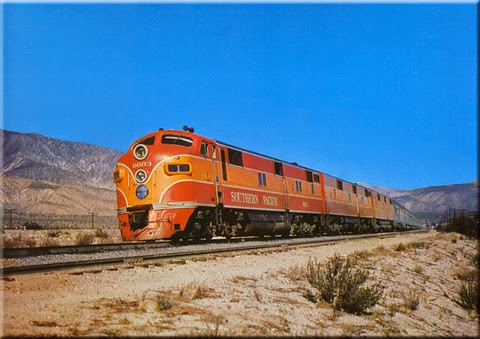
Image: The Southern Pacific's Sunset Limited. probably in the 1950s.

Monday, November 10, 2014

There is a difference between the two parties, and the Koch Brothers know it.

“There's not a dime's worth of difference between the two parties” was one of George Corley Wallace's mantras. In 1968, when he was the American Independent Party's candidate for President, the former Alabama governor said it over and over. And too many Americans believed him. They still believe the line, even if they don't associate it with the onetime segregationist Wallace.

But if there isn't a difference, why did the billionaire Koch Brothers spend millions on Republican Party campaigns? They know there's a difference. But so many people who would be better off with the Democrats in power stayed home. All the voter-suppression tactics of Republican legislatures, nefarious though they were, could not compare in effectiveness to the apathy of a majority of registered voters. Not a plurality—a majority. And while presidential elections usually bring out a higher turnout, voter apathy could be the GOP's greatest ally in 2016.

A November 9 article in the Elkhart Truth by Tim Vandenack made the point all too well. The voter turnout in all of Elkhart County, Indiana for the 2014 general election was only 26.63 per cent. No single precinct managed 50 per cent. But the Elkhart 19 precinct, home of the exclusive Greencroft Goshen retirement community, had the highest turnout with 46.06 per cent. You can bet the vast majority of those votes went to GOP candidates. Rural and exurban precincts dominated the “most engaged voters” list.

It's not hard to guess which areas made the “least engaged voters” list. The Concord 6 precinct, between Main Street and the St. Joseph River, and north of downtown Elkhart, topped the list, with a pathetic 5.27 per cent turnout. It includes “The Hole,” an impoverished enclave in the St. Joseph River flood plain, along with other lower-and lower-middle-class neighborhoods. People living there would have benefited by an expansion of Medicaid for people just above the poverty line, which the GOP state government refused to accept. The federally-funded pre-kindergarten program, just turned down by Republican Governor Mike Pence, would have been a great help to their children.

The next two precincts in Vandenack's “least engaged” column were east or south of downtown, including South Central Elkhart, an area that shares some of the demographics of South Central Los Angeles. The two semi-rural precincts on the low-turnout list included one with a large mobile home park and another with several low-rent apartment complexes.

It's true that there were no major statewide races in Elkhart County. The gubernatorial election follows the presidential election cycle, and there was no Senatorial race this year. Still, there was an important Congressional race, with Republican Representative Jackie Walorski, who last year voted for shutting down the government and against raising the debt ceiling. In both votes, she struck a blow against the United States economy; if her side had won the debt ceiling vote, it might very well have sent the economy into chaos. The poor and lower-middle-class would have suffered the most.

The Democratic candidate, Joe Bock, a thoughtful and compassionate man who had served in the Missouri State Legislature, lost Elkhart County by a landslide—22,873 to 9,334. He carried St. Joseph County (South Bend), normally a Democratic stronghold, by only 563 votes. He deserved better.

What the numbers say to me is that the Republican Party didn't win the 2014 election. We Democrats lost. When a reporter asked the late Chicago mayor Richard J. Daley why Hubert Humphrey lost to Richard Nixon in 1968, he replied, “He didn't get enough votes.” The same line applies to Joe Bock—the Democratic operation didn't get the votes out for him. That means boots on the ground—people going door-to-door and engaging the voters. It's easier to bring out volunteers during a presidential year, when college students often take time off from their studies to support candidates. But the off-year elections are important as well, as the Tea Party victory in 2010 demonstrated. Republican control of state legislatures resulted in gerrymandered congressional and legislative districts drawn to make it even harder for Democrats to win.

So long as vulnerable Americans believe there's not a dime's worth of difference between the two parties, the Koch Brothers and their right-wing Republican machine will keep on rolling up victories.


Tuesday, October 15, 2013

Edith P. Wylder, 1925-2013


In fairy tales the stepmother is almost invariably a wicked woman. And when I first heard of Edith Wylder in the worst of circumstances, I believed she would live up to the stereotype. In the course of some 48 years, I learned differently. So it was with sadness that I learned of her death on July 4 of this year.

 In 1965 my parents divorced. Their marriage had not been a happy one for at least two years and probably longer. It was only after the divorce that I learned of my father's marriage to Edith Perry Stamm. It would be more than a year later, at Thanksgiving in 1966, that I first met my stepmother. By then, my dad and Edith were living in Fort Collins, Colorado. Edith turned out to be a kind, gracious woman, who was quite sympathetic to the situation my brother and I were in.

In the summer of 1967, when I went to stay at Fort Collins, for close to a month, I got to know Edith better, along with her sons Paul and Philip. Though she grew up in a privileged family from the Western Reserve of Ohio and had earned a doctorate in English, she always remained modest. In that summer of 1967, I remember her sitting on the sofa, knitting, and Paul came in and said, “How quaint.” She took it in good humor.

 When Kathleen and I married, Edith welcomed her into the family. Since then, we've had many enjoyable visits with my dad and Edith—first in Marshall, Minnesota, then Murray, Kentucky, and finally in New where they retired. Visiting them meant the long, scenic train ride to Albuquerque, and visits in Rio Rancho and later their little adobe cottage in Corrales, where my dad, Delbert E. “Deb” and Edith lived.

 My dad died December 14, 2005, of leukemia, and Edith told me that not a day goes by that she didn't miss him. During the past few years she had been working on a book to be titled “Talking Between the Rooms,” a study of the influence of John Keats on Emily Dickinson's poetry. She had earlier published “The Last Face,” which analyzed the use of diacritical marks in Dickinson's poetry.

Edith was an inspiration to many students in her long teaching career. But I know her more as a loving stepmother, who always took me seriously.

Edith's ashes will be interred Sunday, October 20 at 11 A.M., in Morrison, Illinois, next to those of Deb Wylder. There was to be a celebration of her life, but there will just be a small family gathering at the Family Chef Restaurant after the interment.

Rest in peace, Edith. 

Thursday, September 19, 2013

"The Unraveling of America," a book for the Reagan era


Sometimes a history book can tell the reader almost as much about the time it was written as the time it was written about. Such is the case with Allen J. Matusow's The Unraveling of America: A History of Liberalism in the 1960s (New York: Harper & Row, 1984).

“It is currently the fashion to pronounce the liberal effort to improve America a failure. Reared in the liberal tradition myself, I take no pleasure in having written a book that, in the main, documents the conventional wisdom.,” writes Matusow in the introduction. (p. xiv—page numbers refer to the Harper Torchbooks edition.) “Currently” means 1983, during the so-called “Reagan Revolution,” when conservatism was triumphant in America, and liberalism was seemingly discredited. One suspects that after the Great Recession discredited the laissez-faire economics of the Ronald Reagan era, even Matusow might reconsider his conclusions.

“The liberal mood of 1960 was largely defined by elite intellectuals residing on the East Coast, principally in New York City and Cambridge, Massachusetts,” writes Matusow (p. 3). One hears echoes of Spiro Agnew's “effete corps of impudent snobs.”

Whether or not “elite intellectuals residing on the East Coast” defined the liberal mood of 1960 is debatable. But William O'Neill, writing in Coming Apart: An Informal History of America in the 1960s (New York, Times Books, 1971), points out that while liberal intellectuals John Kenneth Galbraith, Edwin Reischauer, and Adlai Stevenson were made ambassadors in the Kennedy Administration, “ambassadors do not make policy. In Kennedy's administration the men who did were people like Theodore Sorenson, Dean Rusk, McGeorge and William Bundy, Maxwell Taylor, and Walt Whitman Rostow. They were not so much liberals as technocrats, men of power rather than passion.” (I'd make an exception for Sorenson, but I don't see him as a major policymaker, either.)

Matusow  “proves” liberalism's failure with carefully selected examples, primarily mismanaged programs in the War on Poverty. But he goes beyond analysis and into ad hominem attacks. For some reason, one figure in the Kennedy-Johnson administrations comes in for special opprobrium: “Sargent Shriver, director of the the Office of Economic Opportunity, waged fierce warfare with the Labor Department to win control of the Job Corps, hoping that it would yield instant results and cover him with quick glory. He never made a greater mistake.” (p. 237) On p. 248 Matusow refers to “Shriver's long-standing ambition to run for governor of Illinois,” yet all evidence I've found points to a brief consideration of the run in 1960—hardly long-standing.

Even in praise, Matusow manages to get a dig in at Shriver: “A devout Catholic and husband of Eunice Kennedy, Shriver had a patrician's sense of obligation so profound that he was known within the Kennedy family as the 'house Communist.” (p. 243) Yet over and over Matusow portrays Shriver as the crass opportunist.

Matusow's chapter on the economy is entitled “War, Inflation, and Farewell to Keynes,” and asserts that Keynesian economics was thoroughly discredited during the Kennedy-Johnson years. Milton Friedman, darling of the Reagan conservatives, emerges as a prophet in Matusow's analysis. But if Keynesian economics was dead in 1968, what are we to do with Richard Nixon's 1971 proclamation that “I am now a Keynesian in economics” after taking the United States off the gold standard. (The quote is often confused with Milton Friedman's 1965 “We are all Keynesians now” statement, which Friedman later qualified.)

To me his most interesting, and for the most part, the best-written chapters are in the last half of the book. Unlike Ronald Reagan and most of his disciples, Matusow makes a distinction between the 1960s counterculture, the New Left, and the antiwar liberals. He also understands the nuanced differences within the student civil rights movement.
In “Rise and Fall of a Counterculture,” Matusow gives us the evolution of the 1960s Hippie, from the black hipsters of the 1930s, through the Beats of the post-World War II era, and into the psychedelic era pioneered by the likes of Aldous Huxley and Timothy Leary. Matusow uses Allen Ginsberg, author of the classic 1955 Beat poem “Howl,” as the focus of the transition from Beat to Hippie: “Ginsberg was a new kind of American hero-saint. He had penetrated far enough into the dark recesses of self to risk sanity, and he had returned purified, with reverence for all living things.” (p. 284) Yet his analysis, written from a Reaganite perspective, seems stereotypically Victorian.

“Few hippies read much, but those who did found their purpose strikingly described and anticipated in the strange books of Norman O. Brown,” writes Masutow. (p.277) His analysis of the philosophy behind the counterculture is is very well stated, but today his conclusions ring true only for the cultural conservative. Brown, a Freudian, promoted the releasing the energy of the id—the creative, sexual impulse of Eros. “Like the hippies, Brown was in revolt against civilized sex—exclusively genital, exclusively heterosexual, exclusively monogamous—affirming instead pan-sexualism...” (p. 279)

But Brown had warned of the opposing principle of Eros—Thanatos, or the death wish. (Ethologist Konrad Lorenz, in his brilliant study On Aggression, takes issue with the Freudian concept of the death wish, but in the context of the Matusow's analysis of the counterculture, Brown's warning advances his argument.) Brown proposed a “Dionysian ego” to counter Thanatos, “overflowing with love, knowing no limits, affirming life... The creation of the Dionysian ego, the ego in service of liberated Eros—this was a project project millions of mothers would soon understand and implicitly and fear with good reason.” (p. 279)

Matusow follows the 1967 “Summer of Love” in San Francisco, from the Human Be-In on January 14 to the “Death of Hippie” in October. (A more thoughtful and more sympathetic view of the counterculture in that year can be found in Derek Taylor's It Was Twenty Years Ago Today. [Fireside, 1987].) And he chronicles the slide from Eros into Thanatos, from the Dionysian revels of Monterey Pop and Woodstock to the nightmarish Altamont Festival.

“For a variety of reasons, after 1970 the counterculture faded,” Matusow writes. (p. 305) Yet he admits that it has a legacy, though he sees nothing good in it: “By the 1970s social discipline was eroding so rapidly that fashion condemned the whole of middle-class culture as 'the culture of narcissism.' Parental discipline declined, sexual promiscuity rose along with the divorce rate, worker productivity fell, ghetto obscenity insinuated itself into standard speech, marijuana became almost commonplace, sexual perversions are no longer deemed so, and traditional institutions like the army, the churches, and the government lost authority... Dionysus has been absorbed into the dominant culture and in the process routed the Protestant ethic.” Matusow's alarmist statement ignores that government lost authority as much as a result of the Reagan revolution as the Sixties. And in 1973 the American Psychiatric Association had removed homosexuality from its list of mental disorders, so if Matusow considers it to be a sexual perversion that is “no longer deemed so, his complaint is with a traditional institution.

Matusow has less dire conclusions about the New Left. In his chapter, “The Rise and Fall of the New Left,” he documents its rise from the beginnings of the Students for a Democratic Society to its descent into the violent Weatherman faction. By the 1981 the radical New Left had virtually disappeared—it posed no threat to the Reaganite worldview Matusow embraces. In a similar fashion he covers the Black Power movement, which had virtually disintegrated by the 1970s. Yet the end of black nationalism did not bring African American voters into the Reagan coalition; they continued to vote for liberal Democrats.

The last two chapters of his book, “War, Liberals, and Overthrow of LBJ, and “Rout of the Liberals,” focus on the election of 1968. And again, it's well-written, but seriously flawed. Of the three major (largely) white youth movements of the 1960s, the “Dump Johnson” movement led by Allard Lowenstein was liberal rather than radical, and inspired thousands of idealistic young men and women to trudge through the snows of New Hampshire and Wisconsin for the quixotic antiwar presidential candidate Eugene J. McCarthy of Minnesota. They were crusaders not for some neo-Marxian radicalism, but for the kind of liberalism exemplified by Eleanor Roosevelt and Adlai Stevenson.

What Matusow does not discuss is the break within liberalism which led to both the narrow Humphrey defeat of 1968 and the Nixon landslide of 1972. In 1968, many antiwar liberals sat on their hands or voted for a third-party candidate such as Dick Gregory rather than support Hubert Humphrey. And in 1972, George Meany of the AFL-CIO made the decision not to endorse any candidate in the McGovern-Nixon race, effectively endorsing Nixon, and driving a wedge between labor and the antiwar liberals. Meany did not live to see the fruits of his decision when rank-and-file union members deserted the Democrats in 1980 to elect Ronald Reagan, who spent two terms eviscerating the labor movement.

Because Matusow finished the book in 1981, at the very beginning of the Reagan-Bush era, he could not foresee the disastrous consequences of the laissez-faire economics that dominated those decades. “Whether Reagan's victory made permanent the trend away from the liberalism of John F. Kennedy and Lyndon B. Johnson, whether his conservative policies could weave together the unraveled fabric of the old America, even whether the old America was something that ought to be recovered—these questions were bound to engage historians far into the nation's future.” Matusow concludes. (p. 439)

Today, as we are still recovering from the Reagan Revolution, the nation is more divided than it was in 1968. While some on the far right will agree with Matusow’s conclusions, from this writer’s perspective, he was too quick to endorse the conclusions of the Reagan Right, even though he must have understood that the neoconservative critique of 1960s was based on oversimplification. The book is worth reading, if only to view a more sophisticated critique of the decade than the one given us by most 1980s neoconservatives.


View">http://www.goodreads.com/review/list/16801367-stephen">View all my reviews

Monday, July 22, 2013

Mary Magdalene: A Mary for our time?


Image: Mary Magdalene by Anthony Frederick Sandys


In the sixth century Pope Gregory I gave a sermon that profoundly changed the the reputation of one of the most significant figures in the New Testament. And in doing so, he may have unwittingly given us a Mary for our time:

She whom Luke calls the sinful woman, whom John calls Mary, we believe to be the Mary from whom seven devils were ejected according to Mark. And what did these seven devils signify, if not all the vices? It is clear, brothers, that the woman previously used the unguent to perfume her flesh in forbidden acts. What she therefore displayed more scandalously, she was now offering to God in a more praiseworthy manner. She had coveted with earthly eyes, but now through penitence these are consumed with tears. She displayed her hair to set off her face, but now her hair dries her tears. She had spoken proud things with her mouth, but in kissing the Lord’s feet, she now planted her mouth on the Redeemer’s feet. For every delight, therefore, she had had in herself, she now immolated herself. She turned the mass of her crimes to virtues, in order to serve God entirely in penance.

Mary of Magdala, the first person to declare the resurrection of Jesus, thus became, in Christian art and literature, a reformed prostitute and a symbol of the redeeming power of Christ. Christian writers had been conflating the unnamed sinner in Luke with Mary Magdalene since at least Ephraim the Syrian in the fourth century, but it took a Bishop of Rome, the “first among equals” of the five great metropolitan bishops to cement that connection. While Gregory also conflates the sinner with Mary of Bethany in John's Gospel, the reputation has stuck to Mary Magdalene.

Gregory's sermon also makes the case that Mary, in her earlier life, had been guilty of all seven cardinal sins, thus making her even more a symbol of Christian repentance. But the human obsession with sex was surely there in the sixth century as it is in the twenty-first, and the image of Mary Magdalene has, at least in Western Christianity, been one of a reformed prostitute.

The Roman Catholic, Anglican, and Protestant traditions have until very recently followed Gregory's lead. Until 1969 the Gospel reading for the feast of Mary Magdalene (July 22) in the Roman Catholic Church was Luke 7:36-50 (I'm using the King James Version, though Catholics would have used the Douay Bible or another translation from the Latin Vulgate):

36 And one of the Pharisees desired him that he would eat with him. And he went into the Pharisee's house, and sat down to meat.

37 And, behold, a woman in the city, which was a sinner, when she knew that Jesus sat at meat in the Pharisee's house, brought an alabaster box of ointment,

38 And stood at his feet behind him weeping, and began to wash his feet with tears, and did wipe them with the hairs of her head, and kissed his feet, and anointed them with the ointment.

39 Now when the Pharisee which had bidden him saw it, he spake within himself, saying, This man, if he were a prophet, would have known who and what manner of woman this is that toucheth him: for she is a sinner.
40 And Jesus answering said unto him, Simon, I have somewhat to say unto thee. And he saith, Master, say on.

41 There was a certain creditor which had two debtors: the one owed five hundred pence, and the other fifty.

42 And when they had nothing to pay, he frankly forgave them both. Tell me therefore, which of them will love him most?

43 Simon answered and said, I suppose that he, to whom he forgave most. And he said unto him, Thou hast rightly judged.

44 And he turned to the woman, and said unto Simon, Seest thou this woman? I entered into thine house, thou gavest me no water for my feet: but she hath washed my feet with tears, and wiped them with the hairs of her head.

45 Thou gavest me no kiss: but this woman since the time I came in hath not ceased to kiss my feet.

46 My head with oil thou didst not anoint: but this woman hath anointed my feet with ointment.

47 Wherefore I say unto thee, Her sins, which are many, are forgiven; for she loved much: but to whom little is forgiven, the same loveth little.

48 And he said unto her, Thy sins are forgiven.

49 And they that sat at meat with him began to say within themselves, Who is this that forgiveth sins also?

50 And he said to the woman, Thy faith hath saved thee; go in peace.

It's a powerful story. While the Pharisee Simon is concerned with legalities of a sinful woman touching a man, Jesus says she showed more hospitality to him than Simon. A sinful woman, perhaps a prostitute, is accorded more grace than a righteous Pharisee. And in the passage, Jesus gives hope to women and men who have sinned greatly. But Luke never gives her a name. And a figure so important in Christian theology deserves a name. She has been accorded the name Mary (Miriam) both in Eastern and Western Christianity.

In the Eastern Orthodox churches she's one of the four Marys, along with Mary the Bearer of God, Mary Magdalene, and Mary of Bethany. Here in the West, she became identified with Mary Magdalene. And in much of popular culture she still is. “Bad reputations, though, are hard to live down!” writes Carol Ann Morrow in The American Catholic. Popular works on the Gospels including Franco Zeffirelli's TV minseries Jesus of Nazaraeth, Andrew Lloyd Webber's Jesus Christ Superstar, and Mel Gibson's The Passion of the Christ portray her as a prostitute.

She's been given an exalted title, thanks to Dan Brown's blockbuster novel The Da Vinci Code: that of Jesus' wife. Brown bases his contention on the non-canonical Gospel of Philip, discovered in 1945 at Nag Hammadi, Egypt. Ants had eaten parts of the papyrus, so there are some important gaps in the text:

And the companion of the [...] Mary Magdalene. [...] loved her more than all the disciples, and used to kiss her often on her [...]. The rest of the disciples [...]. They said to him "Why do you love her more than all of us?" The Savior answered and said to them, "Why do I not love you like her? When a blind man and one who sees are both together in darkness, they are no different from one another. When the light comes, then he who sees will see the light, and he who is blind will remain in darkness."

A character in Brown's book contends that the Greek word Koinōnos, translated above as “companion,” really meant “wife.” However, Biblical scholars such as Bart Ehrman say it means “companion.” Brown's book also fills in one of the gaps, saying that the text likely read “used to kiss her often on her mouth.”

If the historical Mary Magdalene was neither harlot nor literal bride of Christ, who was she? Luke 8:1-3 gives us a clue:

After this, Jesus traveled about from one town and village to another. The Twelve were with him, and also some women who had been cured of evil spirits and diseases: Mary (called Magdalene) from whom seven demons had come out—and many others. These women were helping to support them out of their own means.

Most contemporary scholars believe the seven demons, or devils are not a sign of sinfulness, but physical or mental illness. Presbyterian scholar George Buttrick, in his 1962 Interpreter's Dictionary of the Bible, writes: “She had been cured of a serious illness... The number seven would accentuate the serious nature of her condition or possibly its recurrent nature.”

Luke's comment that the women were “helping to support them [Jesus and his disciples] out of their own means” suggests that Mary and her companions had some wealth. Rather than a reformed prostitute, she was more likely a wealthy widow.

In the words of St. Augustine of Hippo (354-430), “The Holy Spirit made Magdalene the Apostle of the Apostles.” She not only supported Jesus financially, she was a leader in his ministry. She stayed with with him during his crucifixion, while the men fled. (The men had good reason to flee, as their presence might very well have led to their execution.) And she was the one to proclaim the empty tomb in Mark and the Resurrection in John.

Today the Gospel for the Feast of Mary Magdalene is John 20:11-18:

Mary stood weeping outside the tomb. As she wept, she bent over to look into the tomb; and she saw two angels in white, sitting where the body of Jesus had been lying, one at the head and the other at the feet. They said to her, "Woman, why are you weeping?" She said to them, "They have taken away my Lord, and I do not know where they have laid him." When she had said this, she turned around and saw Jesus standing there, but she did not know that it was Jesus. Jesus said to her, "Woman, why are you weeping? Whom are you looking for?" Supposing him to be the gardener, she said to him, "Sir, if you have carried him away, tell me where you have laid him, and I will take him away." Jesus said to her, "Mary!" She turned and said to him in Hebrew, "Rabbouni!" (which means Teacher). Jesus said to her, "Do not hold on to me, because I have not yet ascended to the Father. But go to my brothers and say to them, `I am ascending to my Father and your Father, to my God and your God.'" Mary Magdalene went and announced to the disciples, "I have seen the Lord"; and she told them that he had said these things to her.

Yet her “bad reputation” has surely comforted many who could identify with one who has sinned greatly. At least according to the popular image, she's one who's “been there, done that,” as have most of us. The image of Mary the Mother of Jesus as “perpetually virgin,” though perhaps as undeserved as that of Mary Magdalene, is diffuclt for those of us outside Roman Catholic or very high Anglo-Catholic circles to identify with. The reformed sinner might give us a more sympathetic ear. (Maryologists would disagree; I'm suggesting this is the view of someone looking at both Marys only by their popular images.)

It will probably be futile to change the popular image of Mary Magdalene in our lifetime. But perhaps the the Western churches should make a start by taking a page from the Eastern Orthodox churches and honor the woman from Luke 7 as a saint in her own right. Perhaps Mary of the City would be appropriate.


Monday, March 04, 2013

My Dickens Challenge novel is almost here!


Back when I was a much more active blogger, I participated in The Dickens Challenge, begun by mystery writer Tim Hallinan, author of the acclaimed Poke Rafferty novels. The idea was to write a novel the way Dickens did—one chapter a week, with no going back and revising. It was a wonderful exercise, and I read some topnotch writing, including that of Tim himself. My own effort, initially titled Things Done and Left Undone, after more than several revisions, is under contract with Taylor Street Books of San Francisco, under the working title of See You in Chicago.

The idea for the book came as a result of a novel writing contest held by White Wolf Press,h was held to promote two of its popular role-playing games in the World of Darkness series. The vampire world was set in Chicago, so I came up with an idea for a novel that took place during the 1968 Democratic Convention. My novel proposal did not make the first cut, but I couldn't let go of the idea of a story set in the that time and place.

While I still wanted to do paranormal fiction, I was glad to abandon the vampires and set my book in the world of magic. And magical powers are very limited, in this world. As a journeyman mage says to the book's protagonist, “That's the trouble with magic, or maybe its saving grace. We're not gods, even though there are some in the trade who think they are. Sometimes I wish I had unlimited power, but I couldn't trust myself with it. Lord Acton was right: 'Power tends to corrupt, and absolute power corrupts absolutely.'”

The story is set in a dystopian 21st Century, in which the United States has become the fundamentalist Christian Republic of America, but through a complicated series of events, the scene shifts to Chicago, August, 1968.

The protagonist, Thomas Leirmont, an idealistic young reporter, falls in love with a beautiful and mysterious young woman, Helena McKechnie, whose mother was a Zoroastrian Parsi and a descendent of of the Persian magi. Thomas must face a test, and his enemies, aided by Asmodeus, Prince of Lust and King of the Seven Hells, are doing their best to see that he fails. But he has powerful allies in Helena, two journeyman wizards, and benevolent spirits from beyond the grave.

David Dellinger, Jean Genet, Allen Ginsberg, Dick Gregory, Hugh Hefner, Abbie Hoffman, Paul Krassner, Eugene McCarthy, Norman Mailer, Phil Ochs, Jerry Rubin, Bobby Seale, Mary Travers, and Peter Yarrow make cameo appearances.

Once I know the book's publication date, I'll post it here.


Wednesday, January 30, 2013

Sex on the trains: anecdotes from Henry Kisor's "Zephyr"


At the conclusion of Alfred Hitchcock's 1959 film, North by Northwest, Americans were shown the romance of making love on a train. (Immediately after the scene pictured above, where Cary Grant hoists Eva Marie Saint onto the upper berth of a Pullman compartment, Hitchcock cuts to the train going through a tunnel, just to make sure the audience knew what would happen next.) In earlier days before private compartments were common, the lore of the Nights Behind the Green Curtains” enticed many young couples to book a Pullman section, where only the heavy curtains separated them from other passengers traversing the train. The Pullman honeymoon was a grand American tradition.

There are still honeymooners who ride the sleeping cars. (The Pullman Company got out of the sleeping car business in the late Sixties, though older passengers sometimes refer to “Pullmans.”) Of course, it's not just honeymooners and other married couples who make love on the train. And not just in the sleeping cars.

Sex on the train has surely been happening ever since there were trains going any distance. A friend, now in her eighties, recalled seeing a couple have sex in the coaches (under blankets) in the 1940s. I've been reading Zephyr: Tracking a Dream Across America by Henry Kisor (New York: Times Books, 1994), and he has a section about sex on the trains. Here are a a few choice passages:

“Each Superliner sleeper compartment fronts onto the aisle with large glass windows and doors covered by curtains not always drawn completely in the couples' eagerness to get down to business. 'You wouldn't believe the the nonchalance of some of those people!' attendants often say. Casual as they may be about the morality of consenting adults, they're fiercely protective of the sensibilities of the other passengers. To Amtrak crew, sex is not a spectator sport.”

“Very late at night, when the entire train is sleeping except for the conductors huddled in their table far up in the dorm-coach, youngsters for whom nocturnal groping is too tame will tiptoe down to the lower level of their coaches and disport themselves inside the tiny bathrooms. To do so requires an athleticism sometimes defeating to those for whom the bloom of youth has disappeared. A favorite place of assignation therefore is the much larger handicapped bathroom—much to the irritation of wheelchair passengers who need to relieve themselves in the middle of the night.”

(Rather than occupy the accessible restroom, amorous couples could take advantage of the larger dressing room in the lower level of the Superliner coach. It has quite a bit more room than the little cubicle toilet compartments, though not the floor space of the accessible room.--SCW)

...the Starlight had stopped one evening in Sacramento, and [Conductor Glen] Sullivan was offloading passengers from a Superliner coach with a large baggage room on the lower level, separated from the vestibule by a sliding door with a large window. As he helped passengers down onto the stepbox, he said, 'I hear this familiar murmur. People are saying, as they always do when they get off, “Where's my bag, Martha?” and “Joe, have you seen the grip?” But there's a funny gasping in the middle of the murmuring. I didn't think about it at first, but after we got the detraining passengers and we're getting the new ones on, the gasping starts up again. I realize there's something going on here, and look through that window to the baggage room. There they are, completely nude, just having a ball in front of everybody. They were just totally oblivious to what's going on the other side of the door. And I said, “Oh my God.”

'After we hustled everybody upstairs, I went back downstairs and opened the door, and said, “C'mon, folks. You know everyone's been watching you!” The girl said, real enthusiastically and with a big smile, “Yeah.” So I said, “Are you going to be long?” She said, “All night.” I said, “Oh, Jesus.” I went and got one of our plastic trash can liners and taped it over the window on the inside. I don't care what people do so long as nobody sees them. And they said, “Thank you very much.” 'Nice folks,' he added with heavy irony.”

Kisor has several more anecdotes about sex on the trains, and I suspect conductors, trainmen, and on board service personnel on Amtrak and its predecessor railroads can recall thousands more. But such stories surely do not compare with the mystery of Nights Behind the Green Curtains, or the romance of the Pullman honeymoon.

Kisor's book is available as an e-book through Amazon.com and Barnes and Noble, and as a used book in hardback and paperback editions.
Zephyr

Tuesday, December 11, 2012

Naked City revisited


Of the several hundred posts in this blog, I've received the most comments on one called “The Dark Sideof Naked City.” I wrote it during my exile years from late 2003 to the summer of 2009, when I lived and worked apart from my family. At the time I wrote it, I was working in Normal, Illinois, had an efficiency apartment in nearby Bloomington, and would drive back to Elkhart on my Wednesday-Thursday “weekend.” The route I often used took me past the Sun Aura Resort, an adults-only, clothing-optional resort. I never drove into it, as the resort was some distance from the highway, I was curious. It seemed strange that such a place would exist in northern Indiana. There was even a second nudist resort, the Ponderosa Sun Club, across the highway.

But it was the Sun Aura Resort that piqued my curiosity, with its numerous signs. So I looked it up on Google, and learned that it had a long and varied history, beginning in 1933, when Chicago lawyer Alois Knapp, “the father of nudism in America,” founded the Zoro Nature Park, or Club Zoro. I don't know the meaning of the word Zoro, but is was also used in a San Diego nudist park. Knapp was the proprietor until the mid-1960s, after which it was taken over by Albin and Mary Drost, who, in 1968, passed it on to their son Dick, who renamed it Naked City.

Nudist colonies have a reputation for being prudish—almost puritanical—about sex. But Naked City celebrated sexuality, with its Miss Nude Universe and Miss Nude Teeny-Bopper contests, and the Erin-Go-Bra-less dance on St. Patrick's Day.
 
One commenter, writing under the name of Westflyer, said, “In the 1970s and '80s Dick Drost's Naked City, actually a small tacky surreal collection of plywood and tin-foil structures, represented a cross between a blue collar strip joint and a beer chugging stop for long distance truckers. During the summer months strippers turned nudists paraded around a crude stage while men howled their approval as they quaffed liquid courage and added to their already exploding stomachs.”

Obviously the place appealed mainly to men, though some women seem to have enjoyed working and visiting there. But, as I wrote five years ago, the place had a dark side. Dick Drost had a thing for teenaged girls, and in 1985 he was charged with molesting a 13-year-old girl and showing obscene materials to minors. He pled guilty to ten sex-related misdemeanors and avoided prison by agreeing to stay out of Indiana for ten years. He moved west and promptly created Naked City Los Angeles, or NCLA, in Homeland, California. And according to one of the commenters, that was destroyed in a brush fire, and he relocated to Palm Springs. One anonymous writer said he died in a California state nursing home.

Drost was a bizarre character—a quadriplegic from muscular dystrophy who apparently had a group of female admires who tended to his every need, including the sexual ones. (As one commenter wrote, “His equipment worked just fine, the ladies just had to do all the work.”) In a clip from the 1976 movie “Miss Nude America,” he speculates about becoming President, or head of the Soviet Union or China, though he made it clear he wasn't interested in becoming mayor of Roselawn. According to the lawsuit Naked City, Inc. v. Aregood, Drost ran for Governor of Indiana in 1975 (the election was in 1976, so he may have filed for his candidacy in 1975 or the statement was in error).

The lawsuit, which went nowhere, alleges numerous raids against the property and illegal wiretapping and filming, along with illegal seizure of property. It also alleges that the charges Drost pled guilty to were without merit, and that his guilty plea was made only “because of the severe oppression against him...” Nonetheless, he did plead guilty.

And it seems almost certain he was. One woman wrote, “I, unfortunately, worked for Dick for a couple of days before I realized I had to get out of there.” Another woman, who, at the age of 16 was at the Roselawn Naked City with her recently-divorced mother, wrote, “after he figured i was comfortable working nude it moved on [to] being a personal assistant and helping Diane take care of him and eventually working the front counter checking in people and being up front with the 'adults' pretending I was 18 they knew how old i was, end of summer it moved on to sleep with me or you get to be on the street. needless to say that wasnt EVER going to happen.”

Her comment reads like a stream-of-consciousness narrative and ends with, “its too bad i was too young to realize what was happening till it was too late. it wasnt all bad i made some good friends there. My interactions with that man and his sick girlfriend ruined a perfectly good time in my life and today if that bastard was alive id sue him for everything he he has. im not sorry to hear hes dead but i def know know if theres a hell hes getting what he deserves for what he did.”

I don't know where Dick Drost's soul has gone. He surely had personal demons of his own. But I hope the woman who, at 16, had to deal with Drost's unwelcome advances, has found some peace and happiness.


Sunday, November 11, 2012

St. Martin still speaks to us

In the United States, today is Veterans' Day.  Europeans still celebrate it as Armistice Day, to mark the end of the Great War--"the eleventh hour, of the eleventh day, of the eleventh month, 1918."  But it is also the feast day of St. Martin of Tours, patron of soldiers, the poor, innkeepers, and drunkards. I wrote the following piece for "The Winged Ox," the newsletter of St. Luke's Episcopal Church, Philadelphia, back in 2004, when the United States was at war in both Iran and Afghanistan. But while America's wars seem to be winding down, the fourth-century saint still speaks to us.

Peace,

Steve


"Power tends to corrupt, and absolute power corrupts absolutely," wrote British historian Lord Acton.  The feast day of St. Martin of Tours, November 11, celebrates a man who fought the corruption of power in the church.
 
Until the fourth century, the Christian church had little or no power.
When the emperor Constantine made Christianity the state religion in
314, this struggling church was endowed with great, if not absolute
power.

Martin was born in 316, in Pannonia (modern-day Hungary), of pagan
parents.  At the age of 15, he was conscripted into the Roman army,
where he was eventually stationed at Amiens, in Gaul (modern France).  By this time he
had become a catechumen, or inquirer into the Christian faith.  One
winter day, according to legend, he met a half-naked beggar outside the
city gates.  Moved with compassion, he cut his military cloak in two and
gave half to the beggar.  In a dream that night, Christ appeared to him
wearing the half cloak.

Martin then appealed to be released from the army.  He was accused of
cowardice, but offered to face the enemy armed only with the cross of
Christ.  Before the battle began, the enemy sued for peace, and Martin
was allowed to leave the army.  He might be considered the first
conscientious objector.

Martin eventually made his way to Poitiers, in southern Gaul, to become
a disciple of Bishop Hilary.  He lived as a hermit, but attracted so
many followers that he had to establish a monastery.  Legend says that
he did not want to become the Bishop of Tours in 371, but was persuaded
to visit the city to give last rites to a dying woman, and was there
made bishop by acclamation.  As bishop, Martin had no qualms about
destroying pagan shrines.  But he would not accede to the taking of
human life.

Priscillian, bishop of Avila, preached asceticism: vegetarianism,
teetotalism, and celibacy.  His call for the renunciation of marriage
brought him the censure of Church authorities.  The Council of Saragossa
condemned his teachings in 380.  After unsuccessfully appealing to Pope
Damasus I and Ambrose of Milan, Priscillian and six of his followers
appealed to Emperor Magnus Maximus at Treveris (modern-day Trier,
Germany). It wasn't a good move.  The emperor, at the urging of Bishop
Ithacius of Ossanova, had Priscillian and his disciples condemned to death.

For Martin, excommunication, not execution, was the proper punishment
for heresy.  He made the long journey to Trier, where he persuaded the
emperor to remove Priscillian and his companions from imperial
jurisdiction.  But soon after Martin left Trier, Ithacius prevailed on
the emperor to have the men beheaded.  They were the first, though sadly
not the last religious dissenters to be executed at the behest of church
authorities.

Martin refused to communicate with Ithacius after learning of his
treachery.  But later, when Martin returned to Trier to plead for the
release two rebels held by the emperor, Maximus would agree to the
pardon only if Martin would make peace with Ithacius.  Martin did so to
save the lives of the men, though he later reproached himself for his
weakness.  For me, Martin's compassion was his greatest strength.

Martin is the patron of soldiers and beggars.  Because his feast day
coincided with the pagan feast of Bacchus, he is also the patron of
drunkards and innkeepers.  But he also needs to be remembered as a man
of Christlike love, who stood against the abuse of power by church and
imperial authorities.

Illustration: La charité de saint Martin from Heures d'Étienne Chevalier,
illuminated by Jean Fouquet (1420-1480)

Tuesday, September 11, 2012

Junior L. Crews, 1922-2012


Last month we had to temporarily remove part of a chain-link fence in our backyard so a tree removal service could come in. As I was undoing the wire ties, I realized how expertly that fence had been put together. It wasn't done by a professional, but by my father-in-law, Junior L. Crews, who died September 8. For him, it was a labor of love.
 

He wasn't supposed to be named Junior, but James Lee Crews, Junior, when he was born July 11, 1922, on a farm just outside Ravanna, in north central Missouri, just south of the Iowa line. His parents never completed his birth certificate—he was Baby Boy Crews, according to legal records. When it came time to get a proper birth certificate in order to receive Social Security, he had been going by Junior for so long that he made it his legal name.
 
 
He didn't have an easy boyhood growing up on a hardscrabble farm in the 1920s and '30s, and a father with a drinking problem didn't help. When he was a teenager, he had worked all summer to buy an air rifle. His father took Junior's prize possession and hocked it to buy whiskey. And one of his regular chores on the farm was to kill and pluck the chickens. He rarely ate chicken for the rest of his life. When Kathleen and I visited and cooked chicken, we tried to disguise it as much as possible. He'd eat a little bit to please us, but he never really liked it.
 

Like most young men of his generation, he was eager to join up and fight after the Japanese attack on Pearl Harbor. He tried more than once, but a farm accident had left him with no feeling in parts of his right hand, including his trigger finger. The Army wouldn't take him. But the war had affected him. His father had moved his family to Davenport, Iowa, to work in the factories. And for Junior, the move to the city meant he could complete high school. For someone with nerve damage in his right hand, he had quite a bit of artistic talent,from the drawings I've seen. He was older than many in his graduating class because he had to skip a lot of school to work on the farm.
 

It was at Davenport High School that he met the love of his life, a big-city girl from Milwaukee whose family had also come to Davenport for war work. Marilyn Margaret Moon, a lovely brown-eyed brunette, also had a parent with a drinking problem. Both wanted the stability of church and family. After attending several churches in Davenport, they settled on the First Christian Church (Disciples of Christ). One fellow parishioner was so impressed with this bright young man from Missouri that he offered to send him to Drake University, a Disciples school, to study for the ministry. But more practical things intervened, especially after Junior and Marilyn were married in the church on October 8, 1944. He got a job with the City of Davenport and worked for the municipality until he retired at the age of 62. But he stayed with his church, and became a deacon.
 
 
Junior and Marilyn's first child, Constance Carol Crews (Jackson) was born August 4, 1946. Six and a half years later, Kathleen June Crews (Wylder) came into the world on December 30, 1952. Junior and Marilyn loved the outdoors, and took their girls on extended camping trips to many of the National Parks and Monuments, including Yellowstone, the Grand Tetons, Wind Cave, Mount Rushmore, the Great Smokies, and Mammoth Cave.
 
 
Junior set his own pace. One legendary story happened on the trip to Mammoth Cave, when, fascinated by all the cave formations, he lagged so far behind the tour group that the lights were being turned off just behind him.
 

Junior wasn't perfect. He had a temper, as well as a streak of stubbornness. That stubborn streak may have kept him alive for many years longer than anyone expected him to live. Decades of working in Davenport's sewer system had given him a case of emphysema. But he lived to be ninety, and was physically strong into his eighties.
 

I didn't get to know Junior until 1972, when he was fifty, and I was courting his daughter Kathleen. He seemed a bit scary at first—he was protective of his little girl--but when it was clear my intentions were honorable he helped Kathleen and me immensely. During the summer of 1973, before Kathleen and I were married, he took her to estate sales and secondhand shops to get furniture and tools for us. We still have the table he found, along with some tools that will last for generations longer. And when he learned I loved trains, he found two Milwaukee Road railroad lanterns and a switch lock from the Davenport, Rock Island and Northwestern (the DRI Line) for me. I worried a bit about the switch lock, but so far as I know, there weren't any derailments on the line.
 
 
After he retired, he remained active. He and Marilyn spent many summers at Prairie du Chien, Wisconsin, where they kept a trailer and Junior fished on the Mississippi. We enjoyed the bass and Northern Pike he caught in abundance. When our children were born he made child-size furniture, as well as doll beds for the girls. And when we moved to Indiana he came up and put up that fence in our backyard.
 

He was deeply in love with Marilyn right up to the end. In early August, when both of them were in the Good Samaritan Rehabilitation Center, they were able to eat together in the dining room. It was wonderful to see them together, for even in poor health they treasured each other's company.
 
 
When I posted a brief notice of Junior's passing on Facebook, a friend of ours wrote, “I enjoyed meeting him and will always remember Kathleen calling him an 'old coot' with fondness in her voice.”
 

He loved and supported his wife and family, and was generous to all. I was privileged to be his son-in-law.


Sunday, April 15, 2012

A day for us of little faith


The second Sunday of Easter has been a special day for me since my conversion to Christianity more than thirty years ago. And it isn't just because of the beautiful hymn, “O Sons and Daughters Let Us Sing,” though that certainly adds to the experience. But for me, who came to the faith after years of questioning and doubt, St. Thomas's Sunday is something to look forward to. It's called that because the Gospel reading for Roman Catholic, Anglican,and most mainline Protestant churches is John 20:24-29:

24But Thomas, one of the twelve, called Didymus, [the Twin] was not with them when Jesus came.
25The other disciples therefore said unto him, We have seen the LORD. But he said unto them, Except I shall see in his hands the print of the nails, and put my finger into the print of the nails, and thrust my hand into his side, I will not believe.
26And after eight days again his disciples were within, and Thomas with them: then came Jesus, the doors being shut, and stood in the midst, and said, Peace be unto you.
27Then saith he to Thomas, Reach hither thy finger, and behold my hands; and reach hither thy hand, and thrust it into my side: and be not faithless, but believing.
28And Thomas answered and said unto him, My LORD and my God.
29Jesus saith unto him, Thomas, because thou hast seen me, thou hast believed: blessed are they that have not seen, and yet have believed. (KJV)

Too often, Thomas gets a bad rap from preachers because of his unwillingness to believe instantly in the resurrected Jesus. Thomas had not been present when Jesus first appeared to the rest of the disciples in the upper room, where Jesus showed them his pierced hands and wounded side. They had the advantage Thomas lacked. Had one of the others been in the same situation as Thomas, he might have done the same thing. His honesty in not believing blindly has always impressed me. He is the patron saint of those of us who don't always have the mustard seed's worth of faith that Jesus asks of his followers.

But lately I've wondered whether we “of little faith” have had ours strengthened by the fashionable trend of atheism. I'm not talking about people whose atheism comes from honest inquiry, but those who have declared themselves atheists because it's now the popular thing to do.

I first recognized the new reality four years ago, when I was in Chicago for Amtrak block training. It's a two-day training session, so as an out-of-towner, I had a hotel room at the Holiday Inn for two nights. And since I don't have cable TV at home, I was watching MSNBC. Bill Maher's show came on, and I was interested in one of the guests: Reza Azlan, a brilliant Iranian-American writer who has done so much for our understanding of Islam and the Middle East. But first I had to sit through Maher's conversation with the two men behind the cartoon South Park. As usual, I was impressed with Azlan.

It was an intelligent discussion until Maher brought up his atheism. The two South Park guys chimed in that they were atheists, too, and Maher said to Azlan something to the effect of “But you're not an atheist. You're a Muslim.”

Azlan asserted that he was.

And Maher asked him why he didn't join the atheists. I don't remember the exact words, but it had an “everybody's doing it” sound to it.

I realized I had more in common with the Muslim Azlan, a man of faith, than with Maher or the two South Park guys. I do not know how any of the three men arrived at their atheism, but they did not try to persuade Azlan with logic or reason, but with fashion. I do know that Azlan's God is the same compassionate God most Christians and Jews worship. The details—the divinity of Christ, the Trinity, etc.--are far less important than the compassion.

Something is not necessarily wrong because it's fashionable. But it's always best to question anything in the current vogue. And I fear that too many people are embracing atheism without a great deal of thought or introspection.

As for us of little faith, we have the example of Thomas, who had the courage to declare his doubt among an audience of believers. I pray to have the courage to maintain my faith in a popular culture of unbelief.


Friday, April 06, 2012

My ancestors at Shiloh

Today marks the 150th anniversary of the Battle of Shiloh, or Pittsburg Landing, as it was known in the North. Two of my ancestors, James Robert Melton Wylder, my great-great grandfather (pictured), and his father-in-law, John H. Reddish, (add another 'great" there), were officers in the 61st Illinois Regiment. Leander Stillwell, in his classic work The Story of a Common Soldier, includes vignettes about both of them. Reddish had fought in the Black Hawk War, which explains his comments.

Not everyone can say his ancestor was jumping up and down "like a hen on a hot griddle, as Stillwell describes Lieutenenant Wylder:

"Stillwell! shoot! shoot! Why don’t you shoot?" I looked around and saw that this command was being given by Bob Wylder, our second lieutenant, who was in his place, just a few steps to the rear. He was a young man, about twenty-five years old, and was fairly wild with excitement, jumping up and down "like a hen on a hot griddle." "Why, lieutenant," said I, "I can’t see anything to shoot at." "Shoot, shoot, anyhow!" "All right," I responded, "if you say shoot. shoot it is;" and bringing my gun to my shoulder, I aimed low in the direction of the enemy, and blazed away through the smoke. I have always doubted if this, my first shot. did any execution --- but there’s no telling. However, the lieutenant was clearly right Our adversaries were in our front, in easy range, and it was our duty to aim low, fire in their general direction, and let fate do the rest.

And here's Stillwell's account of Captain Reddish:


When we "went in" on the above mentioned position old Capt. Reddish took his place in the ranks, and fought like a common soldier. He had picked up the musket of some dead or wounded man, and filled his pockets with cartridges and gun caps, and so was well provided with ammunition. He unbuckled his sword from the belt, and laid it in the scabbard at his feet, and proceeded to give his undivided attention to the enemy. I can now see the old man in my mind’s eye, as he stood in ranks, loading and firing, his blue-gray eyes flashing, and his face lighted up with the flame of battle. Col. Fry happened to be near us at one time, and I heard old Capt. John yell at him: "Injun fightin,’ Colonel! Jest like Injun fightin’!" When we finally retired, the Captain shouldered his musket and trotted off with the rest of us, oblivious of his "cheese-knife," as he called it, left it lying on the ground, and never saw it again.

Stillwell's book is in the public domain, and is available through Project Gutenberg.

Wednesday, December 28, 2011

Why I've used my full legal name on Facebook and for publication, or I'm not into kinky, thank you

It all started some time in the 1990s, when I got a call from my father, who was living in New Mexico. He had received a call from a collection agency, which was trying to find the whereabouts of one Stephen Wylder. My dad knew I wasn't the one the agency was looking for, as the the said Stephen Wylder had lived in New Mexico as an adult. I lived in Albuquerque from 1958, when I was six, until 1965, when I was all of 13. He wisely didn't tell the representative any information about me, because the agency probably probably would have gone after me anyway.

It was a bit unsettling to know there was somebody else out there with my name—especially somebody with a credit problem. There just aren't that many Wylders in the United States. Most are descended from Wiley Wylder, son of Moses Wilder. There are different stories about why Wiley changed the spelling of his name. One tale is that it was a dispute over some land. My wife thinks Wiley just couldn't spell. In any case, Wiley changed the spelling to “Wylder” and moved from North Carolina to Illinois. In 1861 his son, James Robert Melton Wylder, the grandson of a Virginia slaveholder, was commissioned a second lieutenant in the 61st Illinois Infantry Regiment. It's possible I'm a distant relative of Douglas Wilder, the first (and so far the only) African American governor of Virginia, but that's another story.

It must have been around 2000 when I found Stephen Wylder again, thanks to the Internet. I “Googled” my name, though I suspect I used Alta Vista or Dogpile back then, and found there was a Stephen Wylder in California, who claimed to be a priest in the “Preterite (Anglican) Church” in California. While I know nothing about the Preterite Church, I am an Anglican (Episcopal Church—not one of those sects that broke away over the ordination of women and/or gays). There was also a Stephen Wylder in the San Diego area who posted on a message board for men who were in search of a dominatrix. (I kid you not.)

Given the possibilities for confusion, I began using my full name, Stephen Crews Wylder, when I wrote for publication. I also used it on for my Facebook page. The trouble is, it looks as though there should be a should be a Roman numeral and perhaps a title of nobility after it, though my wife, Kathleen Crews Wylder (I changed my middle name to her maiden name a la John Ono Lennon.) is the one who can trace her lineage to nobility. She's a descendant of John, Lord of the Isles, of Scotland.

Recently I learned that a Stephen Wylder had died in California. He was the same age as I, and whether or not he was the same Stephen Wylder who had me worried in the past I haven't seen any references to the Preterite Church or dominatrices attached to my first and last name in many years.

So I'm going back to plain Steve Wylder on Facebook, if I can figure out how to change it, but I'll stick to Stephen Crews Wylder for publication.

Meanwhile, if I'm ever in North Bay, Ontario (and the only reason I can think of going there is to ride the Polar Bear Express up to Moosonee), I can stop in at Wylder's Bar and Grill. Maybe I'll get a free drink.