I didn't watch the first presidential debate last night. I listened to it on the radio. And while I thought Barrack Obama won on points, John McCain came through as a reassuring elder statesman--a man who could soothe the public in spite of policies that promise to turn the current recession into a depression. (You don't slash government spending during a recession. By throwing more and more people out of work, such drastic cuts can cause a snowball effect. You don't tax employer-provided health insurance unless you want take away health benefits for hundreds of thousands of Americans.)
But Kathleen watched the debate. McCain, she said, came off as an "angry old man." The latest polls seem to bear this out, with Obama perceived as the winner by a skight margin.
It reminds me of another presidential debate, exactly 48 years before yesterday's debate, between Vice President Richard Nixon and Senator John Kennedy. I was eight years old in 1960, so I don't have clear memories of it at the time. But I've seen and heard recordings of the debates.
In the first debate, held September 26, 1960, most listeners perceived Nixon as the winner, while Kennedy was the clear victor with television viewers. Here's a summary from the Museum of Broadcast Communication:
... In August, Nixon had seriously injured his knee and spent two weeks in the hospital. By the time of the first debate he was still twenty pounds underweight, his pallor still poor. He arrived at the debate in an ill-fitting shirt, and refused make-up to improve his color and lighten his perpetual "5:00 o'clock shadow." Kennedy, by contrast, had spent early September campaigning in California. He was tan and confident and well-rested. "I had never seen him looking so fit," Nixon later wrote.
In substance, the candidates were much more evenly matched. Indeed, those who heard the first debate on the radio pronounced Nixon the winner. But the 70 million who watched television saw a candidate still sickly and obviously discomforted by Kennedy's smooth delivery and charisma. Those television viewers focused on what they saw, not what they heard. Studies of the audience indicated that, among television viewers, Kennedy was perceived the winner of the first debate by a very large margin.
I wish Obama had sounded less professorial ("He was a professor," Kathleen reminded me.) and McCain less reassuring. But if McCain came off as an angry old man on the small screen, he may just be 1960 Nixon Redux.
Saturday, September 27, 2008


Thursday, September 18, 2008
Hurricane Ike Hits Indiana
We don’t have hurricanes in the Midwest. We get virtually every other form of natural disaster: floods, tornadoes, forest fires, snowstorms, hailstorms, ice storms, earthquakes (though the last Big One was in the early 1800s), droughts, and heat waves, but no hurricanes. Those are for people living near an ocean. The trouble is, we get the remnants of hurricanes, and they can be almost as bad as the real thing.
Last weekend northern Indiana got over a foot of rain. I should have realized that the Borman Expressway would be flooded when I started driving east from Galesburg last Sunday afternoon. The Borman (named after astronaut Frank Borman, not Nazi Martin Bormann, though sometimes I think it ought to be) is a six-to-eight-lane highway extending from the Illinois border to the Indiana Toll Road exit at Lake Station, a distance of about 15 miles. It funnels virtually all the auto and truck traffic coming from Chicago and points west to Indiana, Michigan, and points east. When it shuts down, it’s a traffic nightmare. The alternatives are to go south to U.S. 30 or to head north into Chicago and get on the Skyway.
I was blithely driving Interstate 80 (the Kingery Expressway on the Illinois side), listening to a fascinating public radio program, “To the Best of Our Knowledge” about Generation X and its resentments against Boomers like me and Millennials like my kids, when I encountered a jam blocking all but the left lane of traffic. I stayed on the right, as the left lane would take me to Wisconsin. When I got to the Lincoln Oasis (a rest stop built over the highway), I could see flashing blue lights down the road. An accident, I thought.
But when I got back on the road it was clear that it was more than an accident. I was diverted off the Kingery and headed south. There were no signs or warnings, and public radio wasn’t giving traffic updates. (I couldn’t switch to AM because the space-age radio in my car didn’t come with instructions, and there was nothing that indicated AM.) By that time, I knew I’d need to make a 50-mile detour, as truck traffic would make a shorter detour even longer.. I got back to Elkhart about 2 a.m. Monday. A little before ten that morning I got a call from my son, who said he was coming home from college. Hanover College had no electricity and no water. The school would be closed for a week.
Southern Indiana got high winds and even worse flooding. When Jim got home, he called it the Hanover Apocalypse. Students were walking around muttering, “What do I do?” First the school planned to have classes on Monday, but then realized that with the water tower empty and no power to pump water into it, Hanover would have to close. Luckily, Jim got a ride with a friend who was from Elkhart. Otherwise we would have had to drive down and pick him up.
I got back to Davenport Tuesday night with a minimum of delay, though the Borman was still blocked. Still, I’m not used to hurricanes, or the remnants thereof, causing so much damage in the Upper Midwest.
Monday, September 15, 2008
The Original Maverick
In a new irritating advertisement, John McCain and Sarah Palin are described as "the original mavericks." Like so many of the other McCain ads. it's misleading. (An earlier ad proclaimed that Barack Obama was "ready to raise taxes," though McCain wants to tax employer-provided health insurance--a huge tax increase on the middle class.) But the innuendos about Obama and the half-truths about Palin's accomplishments are par for the course. But "original mavericks?" Whether the are mavericks in any sense of the word is problematic. But there's only one original maverick, and it's not John McCain or Sarah Palin.
The term maverick comes from Samuel Augustus Maverick (1803-1870), a Texas lawyer, politician and rancher. He fought in the Texas Revolution, first opposed, and then supported the secession of Texas from the Union, and was a major landowner. But his nickname came from his practice of not branding cattle. According to Wikipedia, "Maverick steadfastly refused to brand his cattle. As a result, the word maverick entered the English lexicon, meaning both an unbranded range animal as well as a slang term for someone who exhibits a streak of stubborn independence. Maverick's stated reason for not branding his cattle was that he didn't want to inflict pain on them. Other ranchers however, suspected that his true motivation was that it allowed him to collect any unbranded cattle and claim them as his own."
McCain isn't the original maverick, but his television ads--from the "Summer of Love" to the Britney Spears/Paris Hilton commercial to the current "Original Mavericks" ad demonstrate the kind of deception for personal gain that Samuel Maverick was accused of.
Thursday, September 11, 2008
My Vote Hasn't Counted
Lisa Kenney of Eudaemonia, in a very thoughtful post about presidential politics, admitted she hadn’t voted a lot in the past. Which brought the following response from Larramie of Sieze a Daisy:
Your admission, "I think I've only voted in one other Presidential election, which just goes to show how indifferent I've been in the past.," truly stunned me since your vote counts no matter who is running in what year.
For most elections, Larramie’s statement is true. But American presidential elections are a definite exception. While I expect to vote in the 2008 presidential election, I will do so with the firm expectation that my vote will not count, as it hasn’t counted in every presidential election I’ve voted in--and I’ve voted in every one since 1972.
The reason is, of course, the Electoral College. When I cast my ballot for Barrack Obama, I really won’t be voting for him, but for a slate of electors pledged to vote for him in December, when the real presidential election takes place. Had Obama chosen Evan Bayh as his running mate, my vote might have counted for something. But chances are, Indiana will go for McCain, and the electors from Indiana will go for McCain in the real election.
While I’m proud to say that I cast my first presidential vote for George McGovern, my vote didn’t count. Iowa went for Nixon. Four years later, Jimmy Carter won the election, but without my help. Iowa’s electors voted for Gerald Ford. By the time Iowa started voting Democratic, I was in Illinois, which went for Bush in 1988. And I’ve been voting in Indiana since 1992.
It seemed possible that we might change the presidential election process after 2000, when George W. Bush lost in the popular vote to Al Gore, and won the election by a five to four vote in the Supreme Court, which gave Florida’s electors to Bush. But it didn’t happen. For one thing, a Republican Congress wasn’t likely to support a constitutional amendment making a Republican victory more difficult.
One interesting idea to reform the Electoral College is one I believe was proposed by Curtis Gans, which would allot two additional electors from each state to the candidate who wins the popular vote. While it wouldn’t eliminate the Electoral College, it would make the travesty of 2000 a near-impossibility.
I encourage everyone to vote in the coming election. Even if you’re voting for Obama in Indiana or McCain in Illinois. There’s always hope. And then we should push for a constitutional amendment to assure that all of our votes will count in the future.
Friday, September 05, 2008
Chicago 10
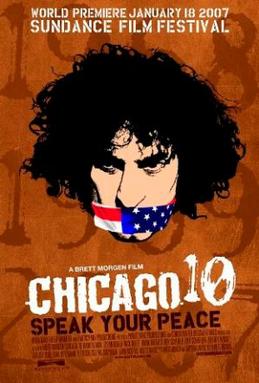
I missed Chicago 10 during its theatrical realease, as it was shown only in large cities, while I was in Bloomington, Illinois and Elkhart, Indiana. It's out on DVD now, and it's well-worth the price. The film mixes actual footage from the demonstrations and the "Festival of Life" during the 1968 Democratic Convention with an animated re-enactment of the Chicago Eight conspiracy trial, in which eight members of the Yippies, the Mobilization Against the War, and the Black Panthers (Bobby Seale) were tried for crossing state lines to incite a riot. (When Seale was separated from the rest of the defendants, it was known as the Chicago Seven trial.) The name "Chicago 10" was taken from a quote from Jerry Rubin: "Anyone who calls us the Chicago Seven is a racist. Because you're discrediting Bobby Seale. You can call us the Chicago Eight, but really we're the Chicago Ten, because our two lawyers went down with us."
Brett Morgen's film was particulary impressive because it provided archival film not easily available, especially of the Lincoln Park police attacks. It gives me a much better idea of the actions of the crowds and the police, which until now, I've had to glean from books and newspaper articles.
Morgen was born in October 1968, after the police riots of August. Because he could look at the events without having lived through them, he gives us a fresh view. I was disappointed that the DVD did not have additional archival footage in the special features. Perhaps we'll get something like that in a subsequent DVD resease. But Chicago 10 is simply a fascinating movie, both in the use of archival footage and the brilliance of the voice actors. Roy Scheider as Judge Julius Hoffman, Jeffrey Wright as Bobby Seale, and Dylan Baker as David Dellinger stand out, but all the voice actors are thoroughly believable. According to the Wikipedia article, there will be two more Chicago 10 films. I'll be looking forward to them.
Monday, August 11, 2008
Hoosiers, Suckers, Badgers, Hawkeyes, and Pukes
Tea N. Crumpet, in a comment on my last post, asked, "What's a Hoosier?" That got me musing about state nicknames. The 1860 campaign song, "Lincoln and Liberty" mentions not only Hoosiers, but an Illinois nickname that's rarely heard now.
We'll go for the son of Kentucky,
The hero of Hoosierdom through;
The pride of the Suckers so lucky
For Lincoln and Liberty too!
-"Lincoln and Liberty"
The second stanza tells us that Abraham Lincoln was born in Kentucky, lived for a time in Indiana, and was the pride of Illinois. That's right--Illinoisans were once known as Suckers. The Dictionary of Wisconsin History explains the nickname, by way of its definition of "badger:"
The name 'Badger' state for Wisconsin had its origin in the lead mining districts of southwestern Wisconsin. Miners from the south (Illinois) in the early days were in the habit of working in the lead mines during the summer and returning south for the winter, migrating like suckers [a species of fish], hence the name 'Sucker" state. Those who came from the east, however, could not return to their homes in the winter and made for themselves 'dugouts' in the sides of the bluffs and hills, burrowing like badgers, hence 'Badgers' or permanent residents of the Wisconsin country." From Wisconsin: comprising sketches of counties, towns, events, institutions, and persons, arranged in cyclopedic form, ed. by Ex-Gov. Geo. W. Peck (Madison, Wis., Western Historical Association, 1906).
Perhaps the Suckers were lucky, as they weren't called Pukes. Netstate also traces the origin of the Missouri Puke to the Galena lead mines:
The Puke State: This distasteful name is said to refer to the large gathering of Missourians in 1827 at the Galena Lead Mines. According to George Earlie Shankle, PhD, in State Names, Flags, Seals, Songs, Birds, Flowers and Other Symbols, 1938, "...so many Missourians had assembled, that those already there declared the State of Missouri had taken a 'puke.'
Iowans adopted "Hawkeye" before they could be tagged with something more insulting. Here's part of the Netstate entry:
The Hawkeye State: This popular nickname for the state of Iowa is said to have come from the scout, Hawkeye, in James Fenimore Cooper's The Last of the Mohicans, published in 1826. According to the Iowa State web site, "Two Iowa promoters from Burlington are believed to have popularized the name." The nickname was given approval by "territorial officials" in 1838, twelve years after the book was published and eight years before Iowa became a state.
There also seems to be a reference to the Sauk warrior Black Hawk, who died in Iowa. In any case, the Hawkeye nickname seems to have been an effort to pre-empt the adoption of an offensive nickname, such as Puke or Sucker.
Or, perhaps Hoosier. While many Indiana residents, especially in the southern and central parts of the state, take pride in the label, a lot of us in the northern part of the state aren't comfortable with it. The article, "What's a Hoosier?" in the Indiana University Alumni Magazine gives a good overall summary of the term, along with a mention of Senator Dan Quayle's battle with Merriam-Webster to remove the negative definitions of "hoosier" (lower case) from the dictionary. But unlike the Suckers and Pukes, Hoosiers have stood by their nickname, even if it does mean a hick or rube.
Tuesday, August 05, 2008
Will The "Mother of Vice Presidents" Give Birth Again?
Update: No VP announcement, thought an Obama-Bayh ticket is still possible. One drawback: Republican governor Mitch Daniels is likely to win a second term, thanks to his almost unlimited campaign chest. Should Bayh become VP, Daniels would get to appoint his successor.
Barack Obama is coming to Elkhart Wednesday morning (August 6), and there's speculation that he may announce Indiana Senator Evan Bayh as his running mate. If that's true, he'll be following a hallowed tradition in American politics--a Hoosier vice presidential candidate.
I won't be there--I'll be in Davenport, Iowa, trying to catch up on my sleep, and then heading for work on the second shift at Galesburg, Illinois. But I'll be there in spirit. And just maybe, A Hoosier running mate may be the key to Obama's success.
The first Indiana vice president was Schuyler Colfax of South Bend, who had been Speaker of the House before agreeing to be Ulysses S. Grant's running mate in 1868. He was dropped from the ticket in 1872 because of his connection with the Crédit Mobilier of America scandal. While Colfax was never formally charged, the scandal ended his politcal career; he spent his final years giving lectures about the assassination of Abraham Lincoln. He died January 13, 1885, of a heart attack, in a Mankato, Minnesota railway station, after walking nearly a mile in minus 30 degree (Fahrenheit) weather.
After the end of Reconstruction, Indiana was one of three swing states. The Democrats controlled the "Solid South" once the black vote had been suppressed, while Republicans could count on New England the Plains, and most of the upper Midwest. Whichever party took New York and either Indiana or Ohio would win the presidency. Indiana, being the smallest of the swing states, was more likely to get the vice presidential candidate.
Thomas Hendricks had been a congressman, senator, and Indiana governor before becoming Grover Cleveland's running mate in 1884. In 1872 he had received 42 electoral votes for president because Horace Greeley, the Democratic candidate, died after the November election, but before the Electoral College met. He ran for vice president in 1876 with Samuel Tilden, who won the popular vote, but lost in the Electoral College in what many believed to be a stolen election. Hendricks was a conservative Democrat with pro-southern views. His legacy as vice president is negligible, as he died just a few months after taking office. Cleveland was defeated in the 1888 election (though winning the popular vote) by Benjamin Harrison--the only Hoosier to win the presidency.
The third Hoosier VP was Charles Warren Fairbanks, the who was a U.S. senator until he became Theodore Roosevelt's vice president in 1904. The "Indiana Icicle," was a contrast to the ebullient president. His reputation as a teetotaler came to an end during his term, as "Lemonade Charlie" was seen drinking a Manhattan cocktail. Thereafter, he was "Cocktail Charlie." His name lives on, perhaps appropriately, in the city of Fairbanks, Alaska. In 1912, he ran for vice president with Charles Evans Hughes. Unfortunately for him, the Democrats nominated another Hoosier for the second office.
Thomas Riley Marshall, of Columbia City, Indiana, served as vice president for both of Woodrow Wilson's terms. As governor of Indiana, he had pushed through a child labor law, opposed Indiana's sterilization law, and opposed capital punishment, but most of his progressive legislation was thwarted in the legislature.
While Wilson kept Marshall on as vice president during his second term, the two men did not get on well; Marshall had little influence on the president. But he had some great one-liners. His most famous was when he was presiding over the Senate. After sitting through an interminable speech about "what this country needs," he is reputed to have said to the clerk, "What this country really needs is a good five cent cigar." Of his home state he said, "Indiana is the mother of Vice Presidents, home of more second-class men than any other state."
After 1920, Indiana became a solidly Republican state. Since the Franklin Roosevelt landslide of 1936, the last time the Hoosier State supported a Democrat for president was in the Johnson landslide of 1964. The only Hoosier VP since Marshall, of course, was Dan Quayle, whom George H. W. Bush chose for his youth and conservatism, not because he was from Indiana.
If Obama does name Evan Bayh as his running mate, Indiana could once again be a swing state. I'm convinced that had Al Gore made Bayh is running mate in 2000, he'd be finishing his second term. Barack Obama would do well to go to the Mother of Vice Presidents for the second spot on his ticket.
Saturday, July 19, 2008
Virtually Out of the Virtual World
I've been in exile from cyberspace for the past two weeks, and will be mainly out of the loop for three more. I'm still in the process of moving out of my Bloomington apartment while having to work in Galesburg without a day off until early August. I took my PC into Best Buy had and them put in a gigabyte of RAM and a DVD-RW. And I've got it set up in my in-laws' basement. But, sadly, I haven't been able to keep up with my friends in cyperspace. I hope to be back in the blogosphere by mid-August. By then, I may at least have my regular days off. I'll take a cue from SzélsőFa and label this post "whining."
Wednesday, June 25, 2008
A Three-Year Move and a Ten-Year Meme.
Since I began working in the Bloomington-Normal, Illinois Amtrak station in July, 2005, I've been trying get a transfer either to South Bend, near our house in Elkhart, or to Galesburg, Illinois, near my wife's hometown of Davenport, Iowa. At the end of 2006 I had accepted a transfer to South Bend only to find that another employee, who was still on the seniority roster, was entitiled to the job. It turned out that I was lucky not to get the job, as I would have been bumped later on by the elimination of another job.
Just a couple of weeks ago, one of the Galesburg ticket clerks took a job in management, giving me a chance to bid a job there. In the next few weeks I'll be moving out of The Closet Over the Stairs in Bloomington and starting the new job in Galesburg. I'll be staying with my in-laws in Davenport until we can get rid of the house in Elkhart and find someplace to live in Galesburg.
I'll be busy trying to get resettled, so posts will be more sporadic than usual. Chapter 19 of Things Done and Left Undone may take a while to complete. Meanwhile, here's the Ten Year Meme Lisa of Eudaemonia tagged me with:
What were you doing ten years ago?
In the summer of 1998 I was working at the Amtrak Call Center in Chicago, making the long-distance commute from Elkhart (drive to Michigan City, then ride the South Shore train to Chicago). I had enough seniority to hold a 4-day, 10-hour shift, so it wasn't so bad. That fall I'd start writing a column on local history for the Elkhart Truth, which I'd continue writing until 2003.
Anne had finished eighth grade and would start high school in August. Sarah was out of seventh grade. It seems as though middle school, or junior high school, is always a traumatic time. Sarah actually had a good seventh grade, but Anne hated both years of middle school. Jim would be going into third grade. Kathleen was not working outside the home at the time, as I was essentially gone four days a week.
In some ways, 1998 seems farther in the past than 1973, when Kathleen and I were married. But it was a turning point for me: I became a regular, as opposed to a sporadic writer.
Five things on your to-do list for today
Take some more books to Goodwill and continue getting rid of stuff .
Do some laundry.
Fill up the tank in my ancient Toyota.
Drive back to Bloomington.
Get rid of more stuff at my Bloomington apartment.
What would you do if you were a billionaire?
I'm going to pass on this one. Money and I aren't friends --I wish there were some other way to get along in the world. I fear a surfeit of money would be worse for me than my current situation of being up to my neck in Direct Loans for my kids. Money would find a way to get me.
What are three of your bad habits?
General messiness.
A tendency towards pessimism (see answer to previous question).
Procrastination (To-do list was from last Thursday, though the procrastination here is doing the meme--I got all the tasks done).
What are some snacks you enjoy?
My own trail mix (Chocolate chips, unsalted peanuts, and raisins).
Greek olives.
Nutella on French bread (haven't had it in a long time).
High-cocoa dark chocolate (I can even pretend it's good for me).
What were the last five books you read?
Boom! Voices of the Sixties by Tom Brokaw--Brokaw is a journalist, and is more concerned with how the past affects the present than actually understanding the past. He makes the mistake of assuming that the Baby Boom generation made the Sixties. "They [the Boomers] made the Sixties. There's no doubt about that." Actually, there's a lot of doubt. It was his generation--the people born just before and during the Second World War who were the movers and shakers of that decade. Abbie Hoffman, Bob Dylan, John Lewis, Gloria Steinem, John Lennon, etc., etc. Plus some of the "Greatest Generation" such as Jack Kerouac, Allen Ginsberg and Lawrence Ferlinghetti (people he fails to mention in his book, The Greatest Generation). My generation gets stuck with the Seventies and Eighties. However, Jerry Rubin of Brokaw's generation had the distinction for being a Yippie in the Sixties and A Yuppie in the Eighties.
A Freewheelin' Time: A Memoir of Greenwich Village in the Sixties by Suze Rotolo--The best part isn't Rotolo's relationship with Dylan, but her description of the Village scene in the early Sixties.
Name Withheld by J. A. Jance--Not her best work, but entertaining. It was available on cassette, which is what I have in my '90 Toyota.
No one was killed, Documentation and meditation: Convention Week, Chicago, August 1968 by John Schultz--perhaps the best of the books about the '68 convention, though Schultz does take a pro-Yippie view, while viewing the McCarthy volunteers as smug and arrogant (even though his wife was one).
The Self Under Siege - Philosophy in the 20th Century by Rick Roderick (course on tape). Roderick's Philosophy and Human Values course is perhaps the best introduction to philosophy around. Self Under Siege is classic Roderick--brilliance in a West Texas drawl. He discusses Sartre, Heidegger, Marcuse, Habermas, Foucault, Derrida, and others. Roderick's lectures are available on the Web, now--click here.
What are five jobs you have had?
Working the grill and fryer at Henry's Hamburgers in Coralville, IA.
Bus driver (campus bus, Cedar Rapids Transit, and Iowa City Transit).
Rail coordinator for the Midwest office of CIT Tours (agent for the Italian State Railways).
Reservation Sales Agent.
Rate Desk Clerk--dealing with complicated fares and difficult people.
What are five places where you have lived?
Iowa City, Iowa
Albuquerque, New Mexico
Oak Park, Illinois
Elkhart, Indiana
Philadelphia, Pennsylvania
I was born in Peoria, Illinois. Some people find that fact hilarious--kind of like being born in Dull Center, Wyoming.
I'll forgo tagging anyone else. Virtually everyone whose blog I read has done this one anyway.
Monday, June 23, 2008
Hanover--Just up the road from Transylvania
In my last post on my visit to Hanover College, SzélsőFa commented, "It never ceases to amaze me how the names of European cities appear and STAY on the map of the USA." Most of the European city names come from the hometowns of the first white settlers. Lots of Londons, Bristols, Hamburgs and Amsterdams. I think the many Milans (almost all of which are pronounced to rhyme with smilin') and Parises were named because those cities had class and sophistication which the founders hoped would rub off on their towns. Some of Parises and other French-named towns may have been named by the voyageurs who plied the rivers of North America in the years before the French and Indian (Seven Years') War. In what would become the Louisiana Purchase, the French had even more time to name towns. Warsaw, Indiana, county seat of Kosciusko County, was named not by Polish immigrants, but for the capital of Poland, the home country (though not at the time a nation-state) of Thaddeus Kosciusko, the Polish patriot who had fought in the American revolution. A lot of the Spanish names in the Midwest are named for battles in the Mexican-American War--Churubusco, La Paz, Buena Vista, Cerro Gordo, etc.
But I came across one European name that has nothing to do with the region in Europe. While at Hanover, Kathleen and I met some very nice people from Kentucky. We were talking about colleges at lunch, and the Kentuckians were talking about "Transy." I asked if this was Transylvania University, and whether there was any connection between that institution and the Carpathian mountains.
It turns out that Transylvania University was founded in 1780, in Danville, Virginia, and moved to Lexington (now Kentucky) in 1789. What would become Kentucky was known as the Transylvania Colony, from the Latin, "across the forest." So the name came independently of the European region, though from the same Latin root. (According to Wikipedia, the European Transylvania is a Latinization of the Hungarian Erdély, which is derived from Erdő-elve meaning "beyond the forest.")
Thanks to Bram Stoker, the name Transylvania conjures up images of dark castles and vampires, at least in the minds of Britons and Americans. But when Transylvania University was founded, the novel Dracula was more than a century in the future. For Virginians, it just meant the land to the west of the great forest.
Wednesday, June 18, 2008
Off to Hanover

Kathleen and I will be driving down to Hanover, Indiana with our son Jim for the orientation program at Hanover College. The campus overlooks the Ohio River and is said to be one of the most beautiful campuses in the country. The picture, uploaded from WikiMedia, is of Parker Audiorium. We'll be back Saturday night. Beginning this fall, Jim will be a Hanoverian, though not of the Georges of England variety.
Tuesday, June 17, 2008
John Ruskin, John Millais, and the Ideal of Womanhood

A lot of us men idealize women, especially the women we love. I'm guilty. Unfortunately, when the woman falls short of our ideal, which inevitably happens, things can go very wrong. In most cases, we come to realize that our beloved is just as human as we are, and we go on to love her with all her imperfections. Yet sometimes the idealization can go too far. Take the famous case of the critic John Ruskin and Euphemia "Effie" Gray (the model in the painting at left, Peace Concluded, by John Millais). Ruskin had fallen in love with Gray when she was very young, and had written the fantasy novel, The King of the Golden River, for her when she was twelve. They married when she was 18. According to Gray, he was an oppressive husband. That wasn't unusual. What was unusual was that Gray was still a virgin five years after her marriage.
Ruskin had championed the Pre-Raphaelite Brotherhood of artists and had taken a special interest in the painter John Everett Millais. Effie Gray had posed for a Millais' painting, Order of Release (right). Millais then accompanied the Ruskins on a trip to Scotland, where he fell in love with Effie. She had her marriage to Ruskin annulled on grounds of non-consummation and subsequently married Millais.

Why had Ruskin refused to make love to his wife? In a letter to her father, Effie wrote, "He alleged various reasons, hatred to children, religious motives, a desire to preserve my beauty, and, finally this last year he told me his true reason... that he had imagined women were quite different to what he saw I was, and that the reason he did not make me his Wife was because he was disgusted with my person the first evening 10th April." And Ruskin confirmed it in a statement to his lawyer during the annulment proceedings: "It may be thought strange that I could abstain from a woman who to most people was so attractive. But though her face was beautiful, her person was not formed to excite passion. On the contrary, there were certain circumstances in her person which completely checked it."
What was it about this beautiful woman that so repelled Ruskin? Mary Luytens, in a biography of Ruskin, suggested it was pubic hair--he expected her to look like a classical Greek statue underneath her clothes. Other historians have suggested menstrual blood or body odor. We shall never know, but I think Luytens' theory makes the most sense.
Millais seems to have had no problem with Effie's body; they had eight children together.

And there's one more bizarre note to this story: Millais painted this portrait of Ruskin while he was in love with Effie: there must have been an incredible strain between the two men, but they stoically finished the portrait.
The story of Ruskin, Gray, and Millais has inspired a number of stories, plays, films, and even an opera. Check out Wikipedia for the particulars.
Although it's very much a Victorian tale, it's a reminder to those of us who idealize the beloved in body, mind, or personality. These beautiful beings are just as human as we are. (Peace Concluded and Order of Release uploaded from WikiMedia; Ruskin's portrait uploaded from Victorian Web.
Thursday, June 12, 2008
Folk Etymology: Gringos and Long Knives
I recently checked out a tape called "Spanish for Gringos." On the cover of the the accompanying workbook was the following:
gringo n, pl gringos [Sp, alternate of griego Greek, stranger, fr Latin Graecus, Greek] (1849); a foreigner in Spain or Latin America, esp. when person is of English or American origin....
(Webster's Ninth New Collegiate Dictionary)
I'm pretty sure the dictionary is right about the word's etymology. But I had learned a more colorful story: that Mexican-American vaqueros came into contact with Irish-American cowboys after the United States acquired first Texas, and then New Mexico and California. The Irish cowboys were constantly singing the song, "Green Grow the Lilacs." The first two words of the song were slurred into gringo.
What I had learned was folk etymology--what Wikipedia calls "A commonly held misunderstanding of the origin of a particular word, a false etymology." Folk etymologies are usually more interesting than the actual word origin. Sometimes folk etymologies can unfairly cast a bad light on some perfectly innocent words, such as picnic, or phrases such as rule of thumb. But for the most part, folk etymologies can be a lot of fun.
One folk etymology (and who knows, maybe it's true), is the story of how American Indians came to call white Americans "Big Knives," or "Long Knives." The term was first applied to Virginians, then to all white Americans. Here's the story: Francis Howard, Fifth Baron Howard of Effingham, and royal governor of Virginia (served 1683-1692) traveled up to New York Colony to treat with the Iroquois tribe. He had brought with him a translator of Dutch origin. In the course of the treaty making, one of the Iroquois wanted to know the meaning of the name Howard. The Dutch translator, thinking of a Dutch word meaning "hanger" (I'm doing this from memory, so I don't remember the exact word), translated it as "big knife." Thus Virginians, and later all white Americans, became Big Knives, or Long Knives.
Most likely, the term came from the swords the Virginians carried. But the mistranslation story is a lot more fun.
Thursday, June 05, 2008
White Ducks: Jim's Senior Speech

I've had a week off so I could attend my son's graduation from Elkhart Memorial High School. He was chosen to give the senior speech at commencement, so I'm including exerpts from it. I've taken out some of the local and school-specific comments, but gist of the speech is here. A couple of things: Memorial's team is the Crimson Chargers. And Philoctetes was one of the Greeks who sacked Troy; specifically, he slew Paris, the guy who carried off Helen and started the whole sorry business. Photo uploaded from etruth.com. He did a wonderful job with the speech, in spite of some rather bad acoustics. Here it is:
The thing is that even though I've lived here all my life, a whole 18 years, I have never seen a white duck.Yes, I have been to zoos, public parks--even Wisconsin--and I have yet to see one single colorless snow glazed feather. That bugs me. I've heard people whine about the failings of their life, never doing this or that, never having kissed her, found time for him, gotten that job, gone bungee jumping, and through all their griping I can't help but think that I haven't even seen a white duck. I think I'm down on points here. Eleanor Roosevelt once said, "The Future belongs to those who believe in the beauty of their dreams." It turns out that's our commencement topic by the way. And you're probably wondering what that quote has to do at all with ducks. White. Fluffy. Ducks. My Dream is to see this duck. It may be odd, it may be silly, but I believe in this dream. And I really want to see that duck! Obviously, and for the reassurance of my parents, since they're probably crossing their fingers up there about now, I have more life goals then that! I have college in a few months--hopefully I'll pull out a degree in something palpable, and later on a career and family. Those are pretty broad dreams, nearly universal, and something I probably share with most of you here graduating today.
What makes wanting to see that little duck special is the infinitesimal smallness of it. It's like the first stepping stone in a pond, and I intend to dream my way across one stone at a time. I believe in this dream...
Okay, Do you remember when you were five, and you wanted to be not a firefighter, a cosmetologist, a lawyer, or a doctor, but a Jedi? (beat)This seemed to me the perfect career choice for me, a way to browbeat my way to the future and a perfectly reasonable career choice to expend my life on.I didn't limit myself to that career choice though, I also considered being a cowboy, pirate, free range chicken, and Godzilla. However, I have yet to achieve any of these lofty childhood goals. These wishes consumed me, burning my insides like a ghostflame, and brought forth the sustenance for my daily trials...
But now that we can separate fact from fiction, our dreams are not so far-fetched, and we can attain them if we can dig up that cinder we have inside us, believe in it, and nurse it into a fire. Not so we can spit-roast that white duck when I find it, but to give ourselves those devastating dreams powerful enough to burn harder then mere crimson whisps, and charge forward to light the lives ahead of us. These dreams can give us the future sight, to aspire to the best in everything we do. Though we can all still feel like Jedi when we go through those automatic doors at Kroger's. We are consigned to dream the best we can.
And we have--in four years we've had so many dreams, and we've worked for them. In four years we've had a plethora of sports teams go to State, and Steve Stahl conquered that [state wrestling] title like Philoctetes over Troy. We've had some of the best artists in the country.
We've dreamed big. And we've dreamed small.
We've dreamed of not having those silly tardy lockouts.
We've dreamed of chasing those geese off the lawn.
We've dreamed of long nights out, and we've dreamed of senioritis.
We've lived life to the fullest, just like every pop song has ever told us to. And now high school is done. But there are so many more dreams we have to live, so let's keep sleeping in, so years from now we can say we lived in our dreams. So don't forget that burning wish, that yearning wish. It is no death wish, no out of scale dream; it is merely an ember that if we foster, can light a fire for the rest of our lives.
Jim will be going to Hanover College in Hanover, Indiana this fall. He's majoring in English/Creative Writing.
Tuesday, June 03, 2008
"I am half sick of shadows"
Bef ore we were married, Kathleen gave me a book on the Pre-Raphaelites. At the time I had never heard of them. She instinctively knew I'd like them, and I did. The Pre-Rapahaelite Brotherhood was a school of artists in the late nineteenth and early twentieth century which held that the painter Raphael had corrupted painting through his use of classical poses. The Brotherhhod particularly rejected the Mannerist school of painting as mechanistic. Whatever their philosophy, the pre-Rapahelites gave us incredible detail and brilliant use of color. Their themes could be overly sentimental, but their best work shows emphasizes the beauty of nature and the human form. And just sometimes they give us a glimpse into the soul.
One favorite theme of the Pre-Raphelites was the Arthurian cycle of legend, and its many interpretations. Alfred, Lord Tennyson's poem, "The Lady of Shalott," loosely based on the Arthurian legend of Elaine of Astolat, was the subject of several pre-Raphaelite paintings, including three by John William Waterhouse. The poem tells of a woman who is confined to a tower, and is cursed to weave a magic web without looking at the world. When Sir Lancelot passes by her tower, she is so enamored of him that she abandons her loom and sets off in a boat to pursue the knight. Because of the curse, she dies before reaching Camelot.
"'I am Half Sick of Shadows,' said the "Lady of Shalott," pictured above, illustrates the following stanza:
But in her web she still delights
To weave the mirror's magic sights,
For often thro' the silent nights
A funeral, with plumes and lights
And music, went to Camelot:
Or when the moon was overhead,
Came two young lovers lately wed:
"I am half sick of shadows," said
The Lady of Shalott.
The painting now hangs in the Art Gallery of Ontario in Toronto. A larger copy of the painting can be found here. And yes, I fell in love with the woman at the loom the first time I saw the painting. Kathleen doesn't have a lot to worry about. For one thing, the woman's hair and figure are very much like Kathleen's And for another, the painting is from 1916, and the model for the picture has surely passed on.
 ore we were married, Kathleen gave me a book on the Pre-Raphaelites. At the time I had never heard of them. She instinctively knew I'd like them, and I did. The Pre-Rapahaelite Brotherhood was a school of artists in the late nineteenth and early twentieth century which held that the painter Raphael had corrupted painting through his use of classical poses. The Brotherhhod particularly rejected the Mannerist school of painting as mechanistic. Whatever their philosophy, the pre-Rapahelites gave us incredible detail and brilliant use of color. Their themes could be overly sentimental, but their best work shows emphasizes the beauty of nature and the human form. And just sometimes they give us a glimpse into the soul.
One favorite theme of the Pre-Raphelites was the Arthurian cycle of legend, and its many interpretations. Alfred, Lord Tennyson's poem, "The Lady of Shalott," loosely based on the Arthurian legend of Elaine of Astolat, was the subject of several pre-Raphaelite paintings, including three by John William Waterhouse. The poem tells of a woman who is confined to a tower, and is cursed to weave a magic web without looking at the world. When Sir Lancelot passes by her tower, she is so enamored of him that she abandons her loom and sets off in a boat to pursue the knight. Because of the curse, she dies before reaching Camelot.
"'I am Half Sick of Shadows,' said the "Lady of Shalott," pictured above, illustrates the following stanza:
But in her web she still delights
To weave the mirror's magic sights,
For often thro' the silent nights
A funeral, with plumes and lights
And music, went to Camelot:
Or when the moon was overhead,
Came two young lovers lately wed:
"I am half sick of shadows," said
The Lady of Shalott.
The painting now hangs in the Art Gallery of Ontario in Toronto. A larger copy of the painting can be found here. And yes, I fell in love with the woman at the loom the first time I saw the painting. Kathleen doesn't have a lot to worry about. For one thing, the woman's hair and figure are very much like Kathleen's And for another, the painting is from 1916, and the model for the picture has surely passed on.
Monday, June 02, 2008
Bring Back the Zonkers!
 I was prowling the library shelves for books about the 1960s and came across one simply called 60s! by John and Gordon Gavna (New York: St. Martin's Press, 1983). I opened it randomly and saw Screaming Yellow Zonkers! (The exclamation point is part of the product name.) The snack was inspired by the Beatles' animated movie Yellow Submarine. I mentioned Zonkers! to my wife and asked her if she remembered them, and she said, "Screaming Yellow Zonkers! Mmm."
Unlike a lot of 1960s snack food creations, Zonkers! actually tasted good. They were a glazed-popcorn treat much like Poppycock and Fiddle-Faddle. But the combination of the glaze and the creative name made Screaming Yellow Zonkers! a hit for Lincoln Snacks, a Lincoln, Nebraska based company. I hadn't seen the snack in a long time and assumed it had died with the Sixties. Not so, I learned from Wikipedia. They were available until 2007, when ConAgra purchased Lincoln Snacks and immediately discontinued the line.
ConAgra needs to rethink its decision. I suspect that Zonkers! lost popularity mainly because they weren't promoted. A creative ad campaign--Zonkers! were always about creativity--could make this product a hit with a new generation, along with the millions of Baby Boomers who already love them. What about it, ConAgra?
Sunday, May 18, 2008
Bob Dylan, Suze Rotolo, and "The Gypsy Laddie" of Spain

Remember the cover photo on "The Freewheelin' Bob Dylan," with Bob walking arm-in arm with a gorgeous blonde down an icy street in Greenwich Village? I was in my mid-teens when I first bought the record. In those days I yearned to be a folksinger, playing at hootenannies and at the coffeehouses of the Village and Chicago's Old Town. But I yearned even more to have a beautiful young woman on my arm as Dylan had.
The woman on the album was Suze Rotolo, who has just published a memoir about her love affair with Dylan and its eventual breakup. I haven't yet read the book, A Freewheelin' Time: A Memoir of Greenwich Village in the Sixties , but I heard Terry Gross's interview with Rotolo on Fresh Air. Rotolo was only seventeen when she met Dylan, but she was an artist who had worked in the civil rights movement. She was a "red-diaper baby:" her parents were members of the Communist Party. Rotolo introduced Dylan to the music of Bertoldt Brecht and Kurt Weill, which influenced his music.
Rotolo's relationship with Dylan began to crumble when she took the opportunity to go to art school in Perugia, Italy. Dylan did not want her to go. Dylan's song, "Boots of Spanish Leather," was his way of dealing with her leaving. Terry Gross did not seem to realize the significance of the title, though Rotolo, and anyone familiar with the folk scene, surely did. Here's the last stanza:
So take heed, take heed of the western wind,
Take heed of the stormy weather.
And yes, there's something you can send back to me,
Spanish boots of Spanish leather.
Many of Dylan's early songs paid homage to the English and Scottish ballads collected by Francis James Child and the Appalachian ballads compiled by Cecil Sharp. "A Hard Rain's A-Gonna Fall, " for example, is based on "Lord Randal," while "Masters of War" takes its tune from "Fair Nottamun Town." "Boots of Spanish Leather" uses almost the same tune as Dylan's earlier "Girl from the North Country," which references The Elfin Knight, but laments that "She once was a true love of mine," as opposed to the ballad's future tense: "then she will be a true lover of mine." But the song's title refers to another Scottish ballad, "The Gypsy Laddie," or rather its American variant, "Black Jack Davy." In it a gypsy seduces the lady of a manor. Americans weren't familiar with gypsies, so the seducer is usually called "Black Jack Davy." One version calls him "Gypsum Davy." Americans didn't know about gypsies, but they knew gypsum. Here's an American version I learned back in the Sixties:
The landlord he came quickly to his door,
Inquiring for his lady.
The answer that they gave to him:
"She's gone with black-eyed Davy."
"Go saddle up my milk-white steed.
Go saddle and make hasty.
I'll ride all day, I'll ride all night
'Til I overtake my lady."
He rode all day he rode all night
Through waters deep and muddy.
He rode all day he rode all night
'Til he overtook his lady.
"Will you forsake your house and land?
Will you forsake your baby?
Will you forsake your own true love
And go with black-eyed Davy?"
"Yes I'll forsake my house and land.
Yes I'll forsake my baby.
yes I'll forsake my own true love
And go with black-eyed Davy."
"Last night you slept in a fine feather bed
And in your arms your baby.
Tonight you'll sleep on a cold riverbank
In the arms of black-eyed Davy.
"So you take off those high-heeled boots
All made from Spanish leather.
And give to me your lily-white hand
And say farewell forever."
In fact, it wasn't forever. Dylan and Rotolo got back together after she returned from Italy, though they broke up about a year later. But when he wrote "Boots of Spanish Leather," Dylan was sure that his own true love was saying farewell forever.
P.S. I found my beautiful young woman. One thing that brought us together was our love for the old ballads. I knew most of them only as poetry, but Kathleen, after years of listening to records by Jean Ritchie, Jeannie Robertson, and Ewan Macoll, could sing many of them. And in nearly 35 years of marriage, I've never had to ask for boots of Spanish leather.
Monday, May 12, 2008
Exhaustion and Lake Shore Drive
I normally do most of my writing during my swing-shift break. I get off my Sunday morning shift at 2:15p and don't have to be back at work until 115p Monday afternoon. This Sunday, the evening shift clerk called in sick, and I ended up working a double, plus another hour and a half for a late southbound train--545a to 1130p. Needless to say, I was exhausted by the end of the night and was still recovering through my Monday evening shift. Chapter 18 has yet to be written. I seem to have the hardest time working in actual events--in this case, the barricade at Lincoln Park and Hugh Hefner getting swatted with a billyclub. In the meantime, here's a song about the street that connects Lincoln Park and Grant Park, by Aliotta-Haynes-Jeremiah from 1970. The "Hollywood" refers to a street in Chicago. The song was banned on some stations because of references to "LSD." It's just the initials of Lake Shore Drive, though I suspect the songwriters were chuckling to themselves while writing it.
Thursday, May 08, 2008
Won't You Please Come To Chicago?
I'm back from three days in Chicago. While most of my days were spent in customer service training, I was able to do some research and to walk around the downtown area. At the microfilm room at the Harold Washington Library, I was able to copy articles from the Chicago Daily News (the best paper in the city at the time), the Village Voice, and the underground newspaper The Chicago Seed. The Voice had some excellent first-person coverage of the demonstrations from an outsider's point of view.
I read a sad reminder of just how intense the feeling was in those days:
NEW YORK (UPI)--A Columbia University co-ed, despondent over the defeat of Sen. Eugene J. McCarthy for the Democratic presidential nomination, apparently committed suicide with an overdose of sleeping pills, police said.
Beside the body of the student... was an empty bottle of pills and a note saying she had killed herself because "she was depressed over the defeat of McCarthy," police said.
-Chicago Daily News, August 31, 1968
And I read that in spite of the Crosby Stills Nash and Young song, Abe Peck, editor of The Seed, begged people not to come to Chicago:
It's a no-go.
Don't come to Chicago if you expect a five-day Festival of Life, music and love. The word is out. Many people are into confrontation. The Man is into confrontation. Nobody takes the Amphitheater [The International Amphitheater, where the convention was held] Cars and buildings will burn. Chicago may host a Festival of Blood.
-Chicago Seed, v.2, No. 11
The YouTube video, by the way, was a high school history project. The four young men who made it certainly deserved an A.
In my walk around the South Loop, I visited the General Logan statue where protesters "took the hill," walked through the lobby of the Chicago Hilton and Towers (formerly the Conrad Hilton), and viewed the site of the Grant Park battleground. Like most other people, I find omens. I saw a good one Monday night. There, on Van Buren Street between Michigan Avenue and Wabash, was a white Volkswagen Beetle. Not one of the new ones, but one that was on the road in 1968, when my character Helena was driving her white VW between the South Loop and the North Side.
Saturday, May 03, 2008
A break from the Web and a contest entry
I'll be out of the blogosphere for the next few days, while I'm in Chicago for Amtrak block training May 5, 6, and 7. I'm going up early on Sunday so I can do a little research at the Chicago Public Library. In doing research about the demonstrations during the Chicago Convention, I've relied mainly on four books: Rights in Conflict (The Walker Report), Chicago '68 by David Farber, No one was killed by John Schultz, and Norman Mailer's Miami and the Siege of Chicago. I've also had access to the Chicago Tribune on microfilm at the Bloomington Library. But the Trib was a pretty wacky paper in those days--here's the beginning of an August 25, 1968 editorial about Hubert Humphrey:
It will probably occasion little surprise among readers that in his former days around the family drug store in Huron, S. D., Hubert Horatio Humphrey was known to the clientele as Pinkie. But if the readers jump to the logical conclusion that this appellation had something to do with Hubert's political coloration, which is socialist, radical, and left-wing, if not precisely Red, they will be wrong. The tag was hung on him simply because of his complexion.
The Harold Washington Library will have the Sun-Times and the Daily News, and (I hope) The Seed, Chicago's premier underground paper at the time.
In other news, Tim Hallinan is sponsoring the following contest:
In response to something I wrote in the book roundup for April (about my once having eaten lunch with Cary Grant), Sylvia wrote the following sentence:
I once drank a beer in a dirt pit which had previously been Cary Grant’s swimming pool.
Lisa Kenney, who doesn’t miss much, immediately wrote to say that this was a GREAT opening sentence for a novel. I had thought the same thing; in fact, I’d figured out what the basic setup for the book would be. I’ll show you mine in a minute, but first, a contest:
I’ll give away four autographed copies of my new Bangkok novel, The Fourth Watcher, to the four people who come up with the best ideas for a novel that opens with Sylvia’s sentence. If there are more than four good ideas, I’ll sign and mail more books. Here are the rules:
Entries should be sent in the form of replies to this post.
No entry should be more than two paragraphs long.
Entries should be received by Monday, May 12.
The beer-in-the-dirt-pit scene can NOT be a dream sequence, just because I hate books that begin with dream sequences.
Here's my entry--the paragraphs are a bit long:
I once drank a beer in a dirt pit which had previously been Cary Grant’s swimming pool. It was a strange place for a protest meeting, but it was appropriate. It seemed a perfect way to embarrass the Americans for a Classless Society. The ACS has nothing to do with Karl Marx. In fact, it doesn’t even call itself that. Something about progress. But it’s all about a classless society--a society without any class. I don’t know how long the ACS has been around--at least since 1964, when its operatives tore down New York’s magnificent Penn Station and replaced it with the unspeakably ugly Madison Square Garden. Since then, ACS has been hard at work, demolishing anything with class. If ever there was a poster boy for class in America, it was Cary Grant. Even when he played a millworker and fugitive from justice in “The Talk of the Town,” he had class. And the ACS was out to destroy everything connected with him. Including his swimming pool.
My wife and I got involved when the ACS decided to tear down the Blackhawk Hotel in Davenport, Iowa and replace it with a garish Las Vegas-style palace. We had spent our wedding night at the Blackhawk; Grant had stayed the last night of his life there. I had come to California to meet with others who were fighting the people who wanted to replace class with crass. The dirt pit was chosen because it symbolized just how far the ACS would go. But it turned out the ACS was ready for us. We were like the French at Dien Bien Phu--stuck in a valley and surrounded by the enemy. The cops dragged us out of the pit, just as we were finishing our refreshments. The media people, whom we had counted on, were nowhere to be seen. Round 1 for the ACS.
----------------------------------------------------------------------
My wife and I really did spend our wedding night at the Blackhawk, though it was many years before Cary Grant spent his last night on earth there. In 1973 it was a solid downtown hotel, with Maxfield Parrish reprints hanging on the walls. While it's now owned by President Casinos, I know of no plan to replace it with a Las Vegas-style palace.
All the best to my readers. I'll be back in the world of the Web on Thursday.
Subscribe to:
Posts (Atom)